Non-Canonical · Parallel Register · Apocrypha
The Hungry Gods Go Collection
Institutional volumes, travelogues, anthologies, essay-cycles, community encounters, and interactive games from the margins of the Hungry Gods Universe.
Institutional Volumes
14 volumes
Novels, novellas, and document-cycles set inside a single institution over a bounded period. The gods are present and active; the institution is the protagonist.
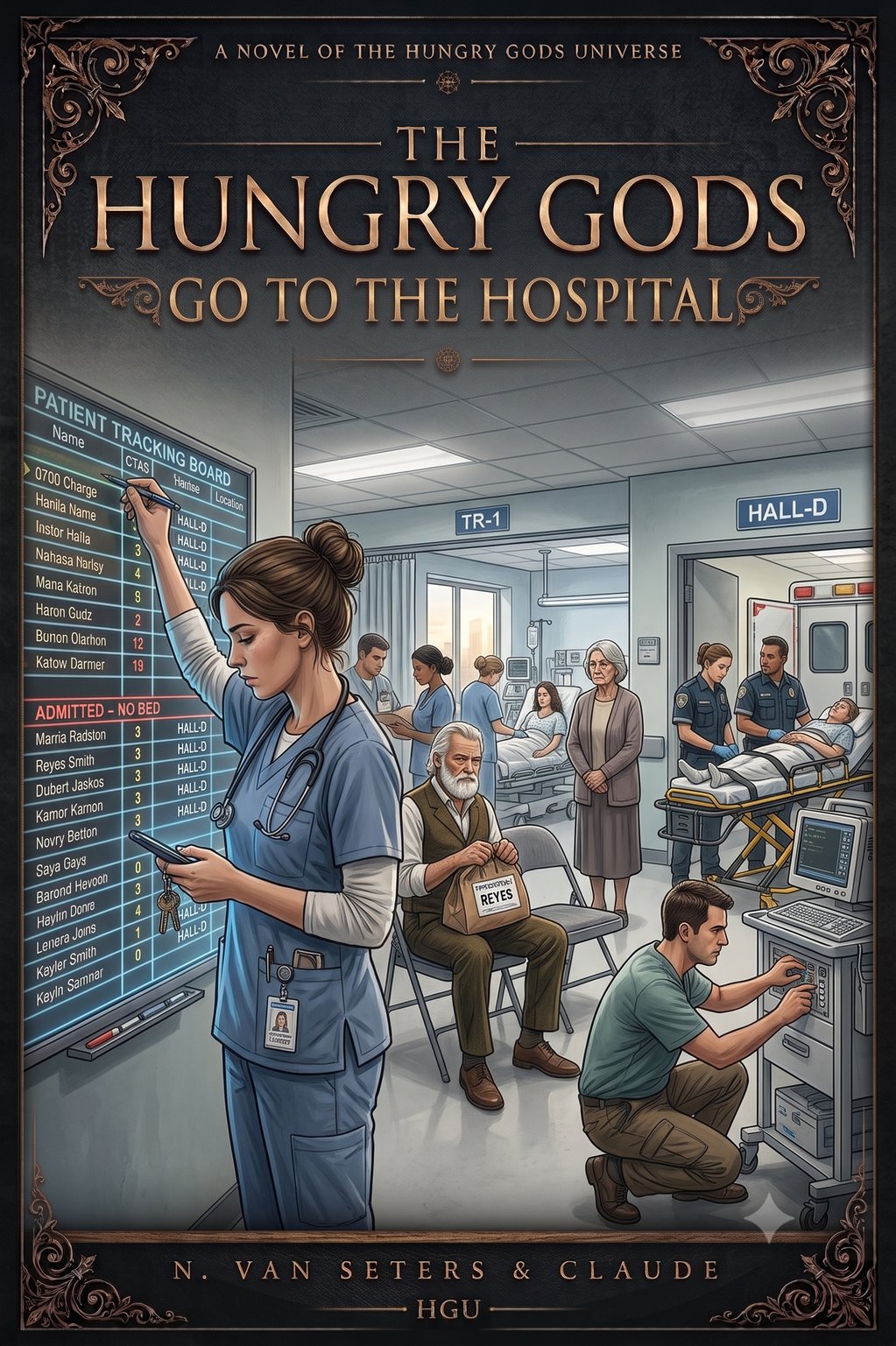 The Hungry Gods Go to the Hospital
A BC emergency department across one dawn-to-dawn shift, told from five recurring seats — charge nurse, administrator, paramedic, porters, and an 811 phone line — plus a porter chorus in script form. Overcapacity crisis, a stand-down declared while the numbers get worse, six of the seven gods present.
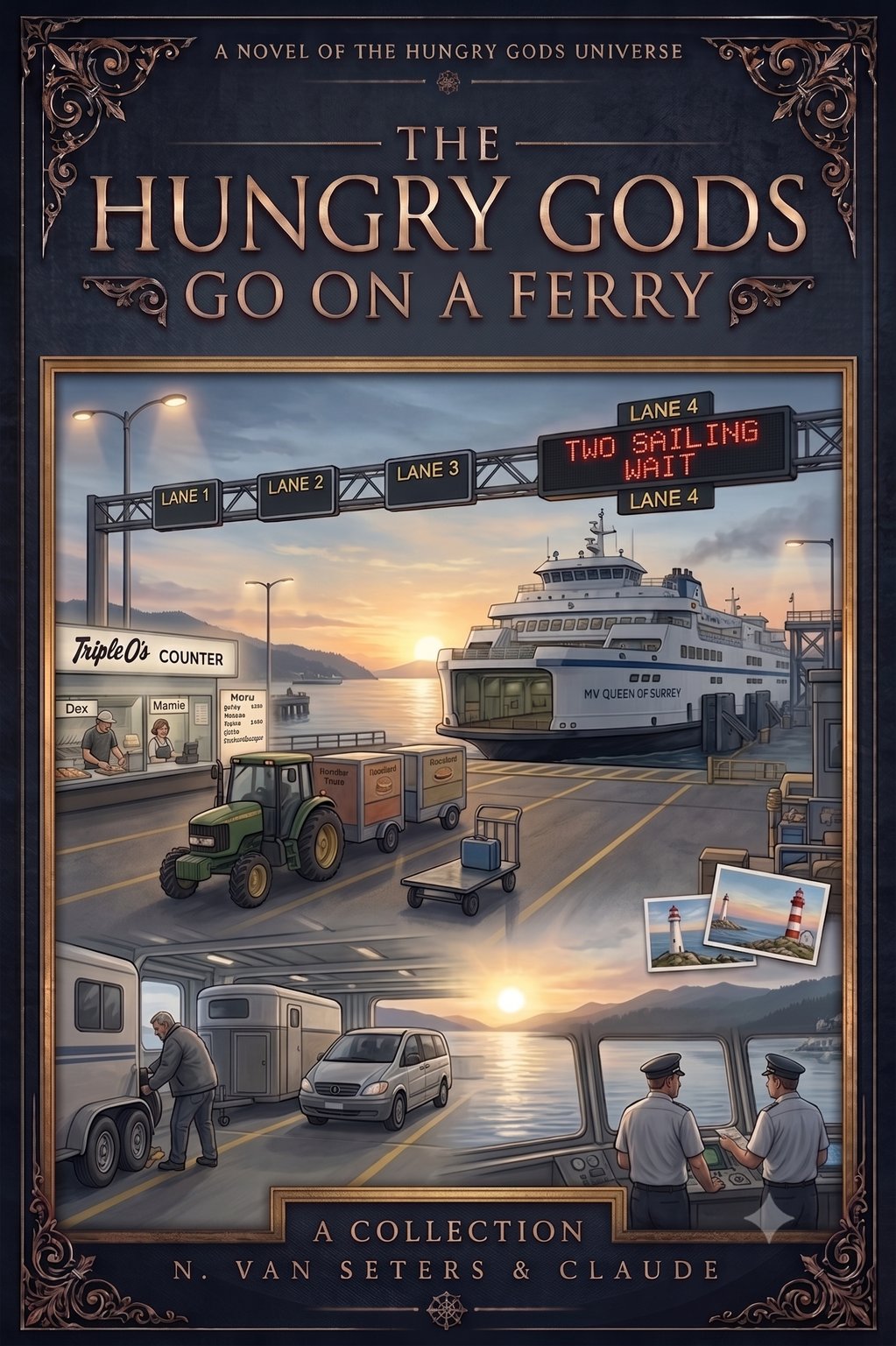 The Hungry Gods Go on a Ferry
A BC Ferries route during an engine breakdown and cascading schedule delay. Uniquely, no epithets are ever used on the page — the gods appear only as unnamed recurring figures. Includes a script-formatted terminal-booth scene and engineering-log documents.
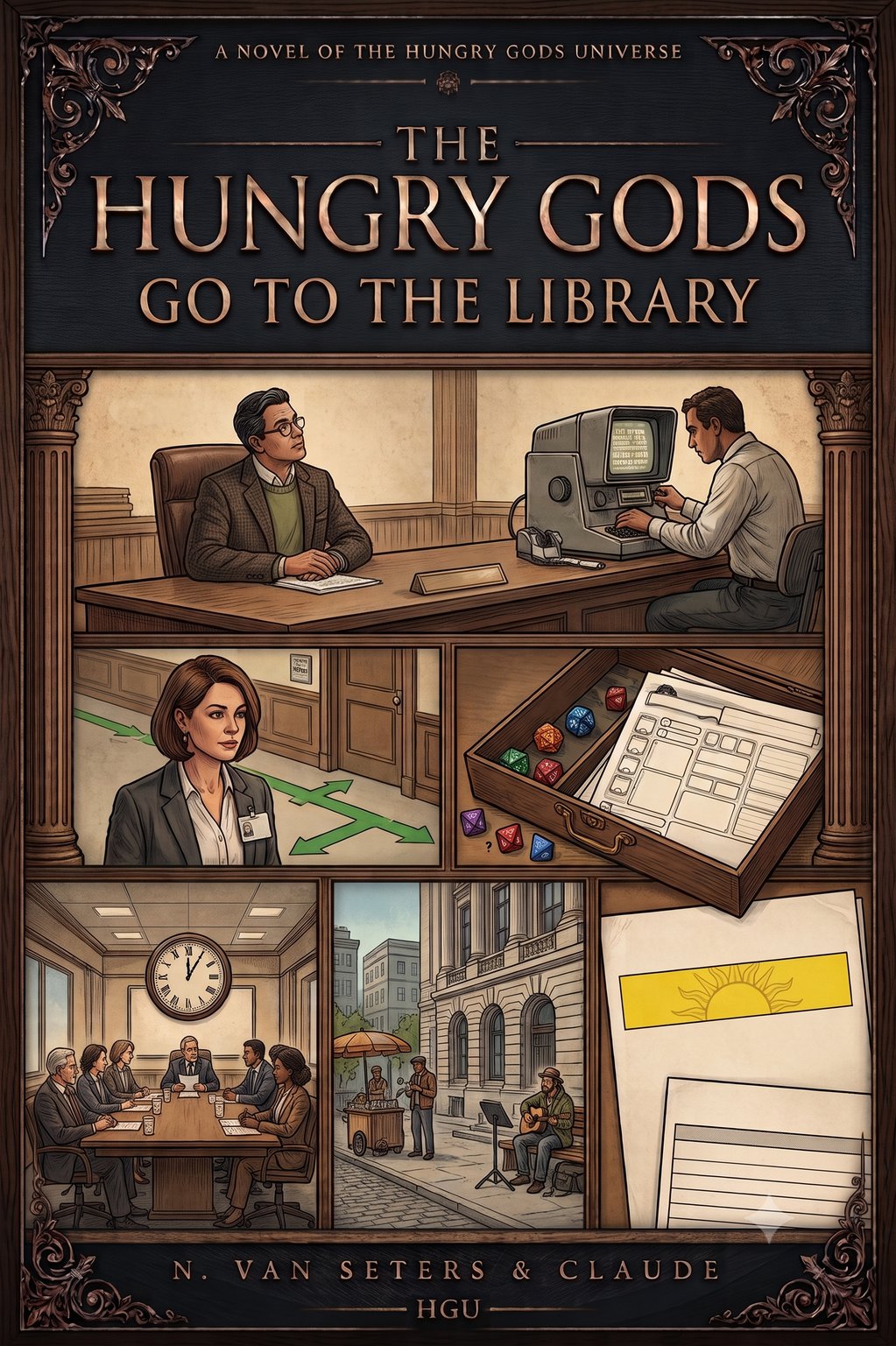 The Hungry Gods Go to the Library
A shared library/rec-centre building over one heat-warning week. The most document-dense volume — board minutes, heat warnings, volunteer logs. Notably, 'the Allfather' is listed by name as a meeting attendee in the board minutes.
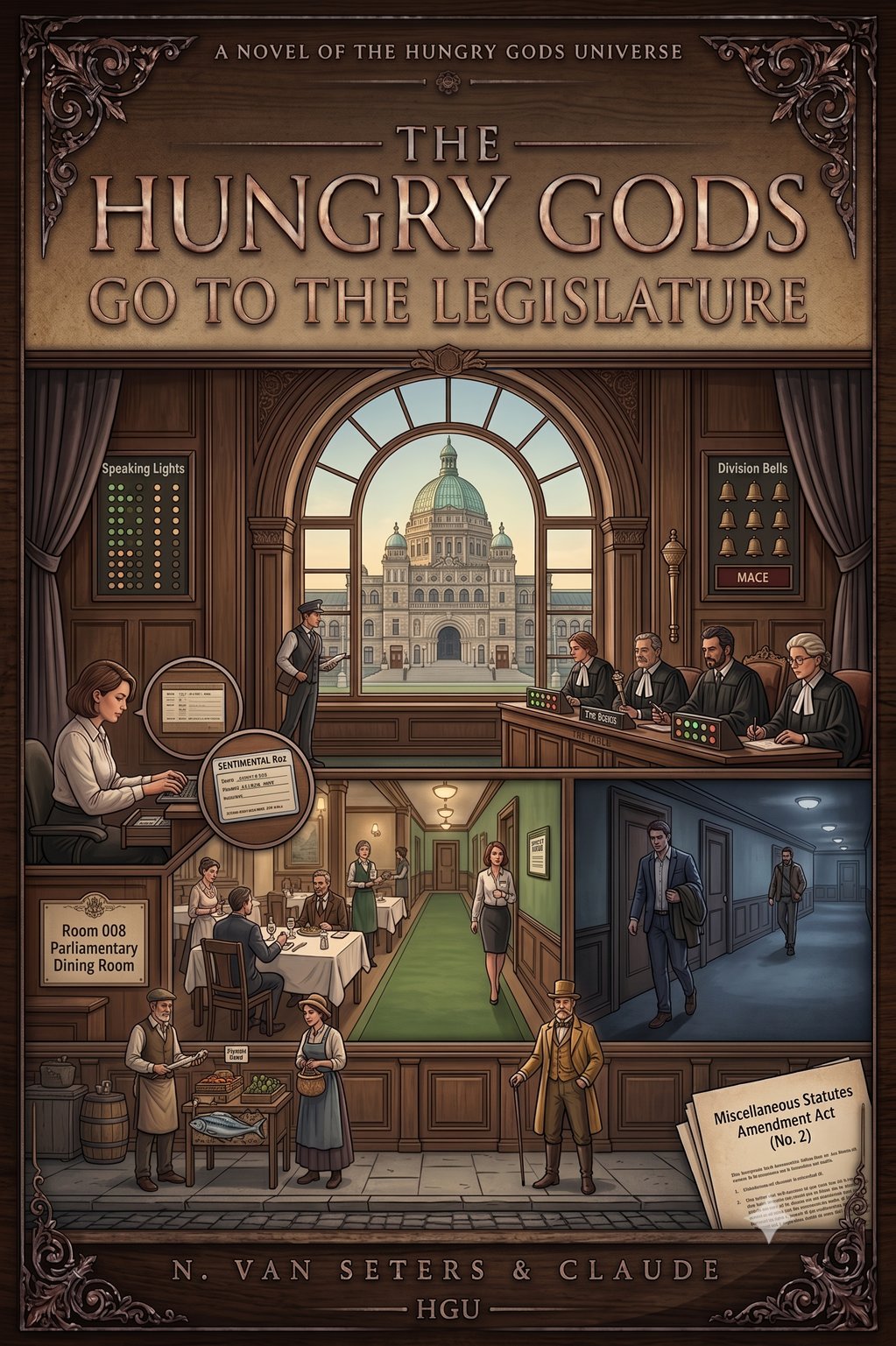 The Hungry Gods Go to the Legislature
A provincial legislature from Throne Speech to Royal Assent, narrated by Hansard staff, then facilities and vendor staff underneath the same session. Gods are tracked entirely through institutional paperwork — sign-in registers, duty rosters — rather than description.
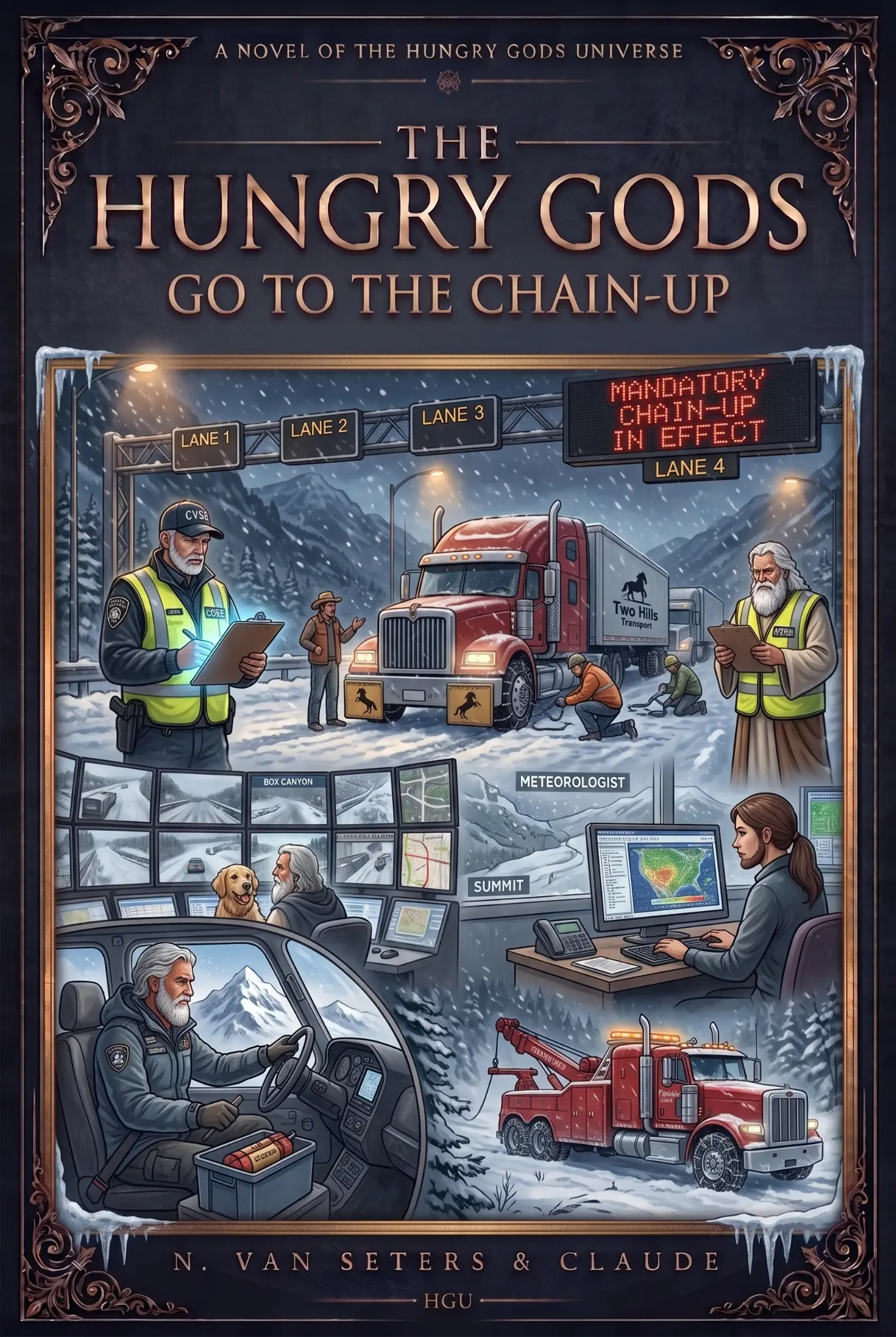 The Hungry Gods Go to the Chain-Up
The Coquihalla Highway during a multi-day winter closure, organized by highway status signage rather than day or seat, with radio-transcript interludes. Epithets are repurposed as literal call signs and roster labels; god presence runs sustained and scene-length.
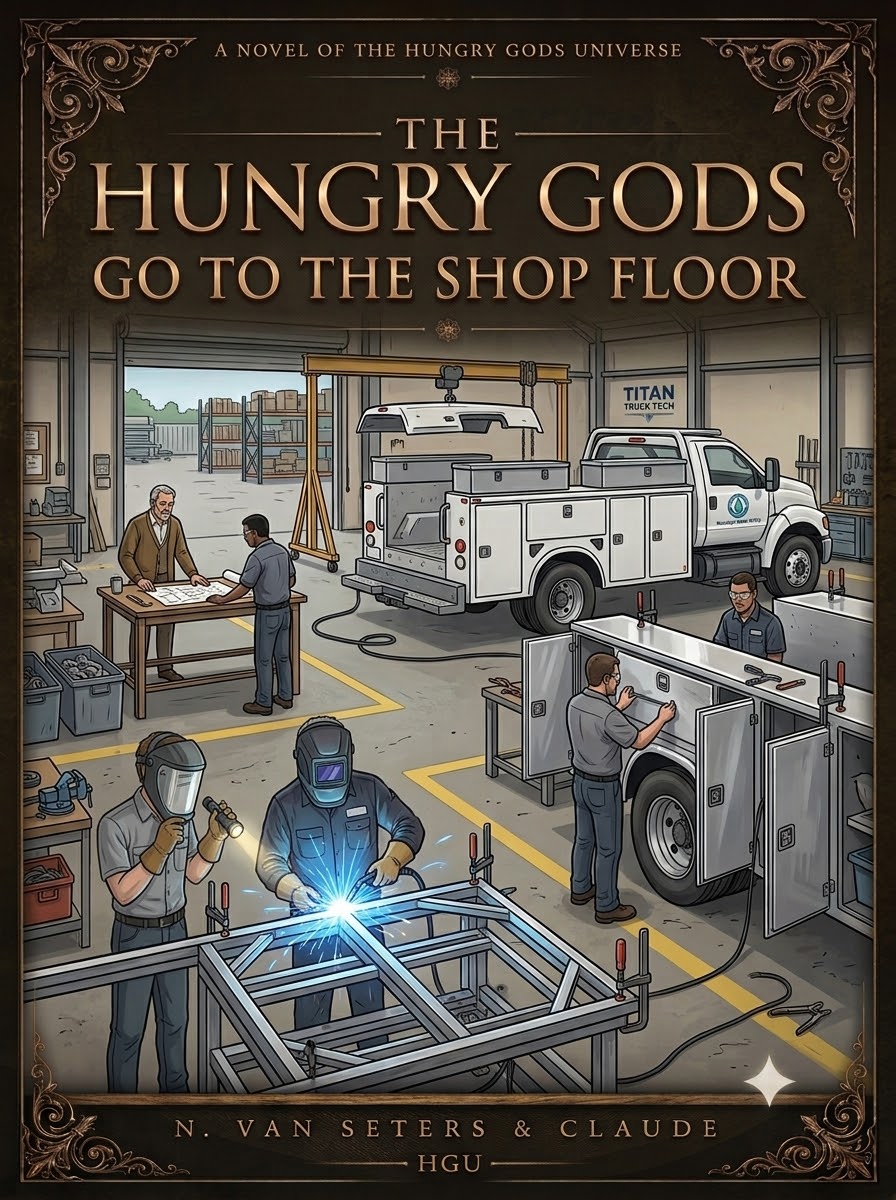 The Hungry Gods Go to the Shop Floor
A first-month apprenticeship at a Fraser Valley truck-body fabricator, told across four weeks of Monday-to-Friday shifts. As Ricky learns safety binders, drawings, blue-taped tools, floor craft, and the unspoken etiquette of breaks, Seeker and Hand appear as ordinary shop colleagues; a finished rescue body becomes the measure of the work.
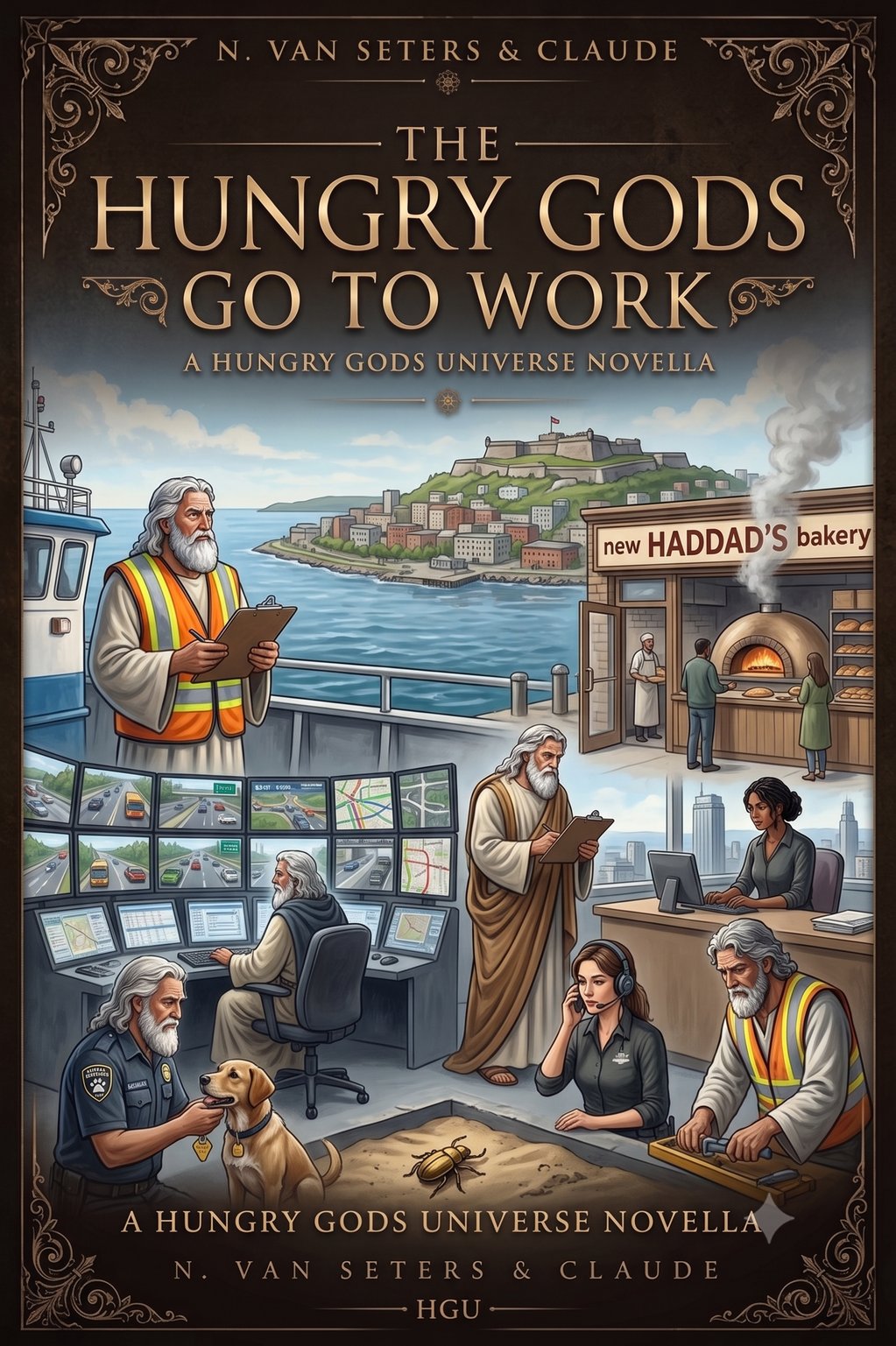 The Hungry Gods Go to Work
A Halifax civic-government novella — public works, 311, planning, bylaw — set against a wildfire season and a family opening a bakery. Explicit thesis line: 'what do gods do all day? … they carry the water … it is only not the bread.'
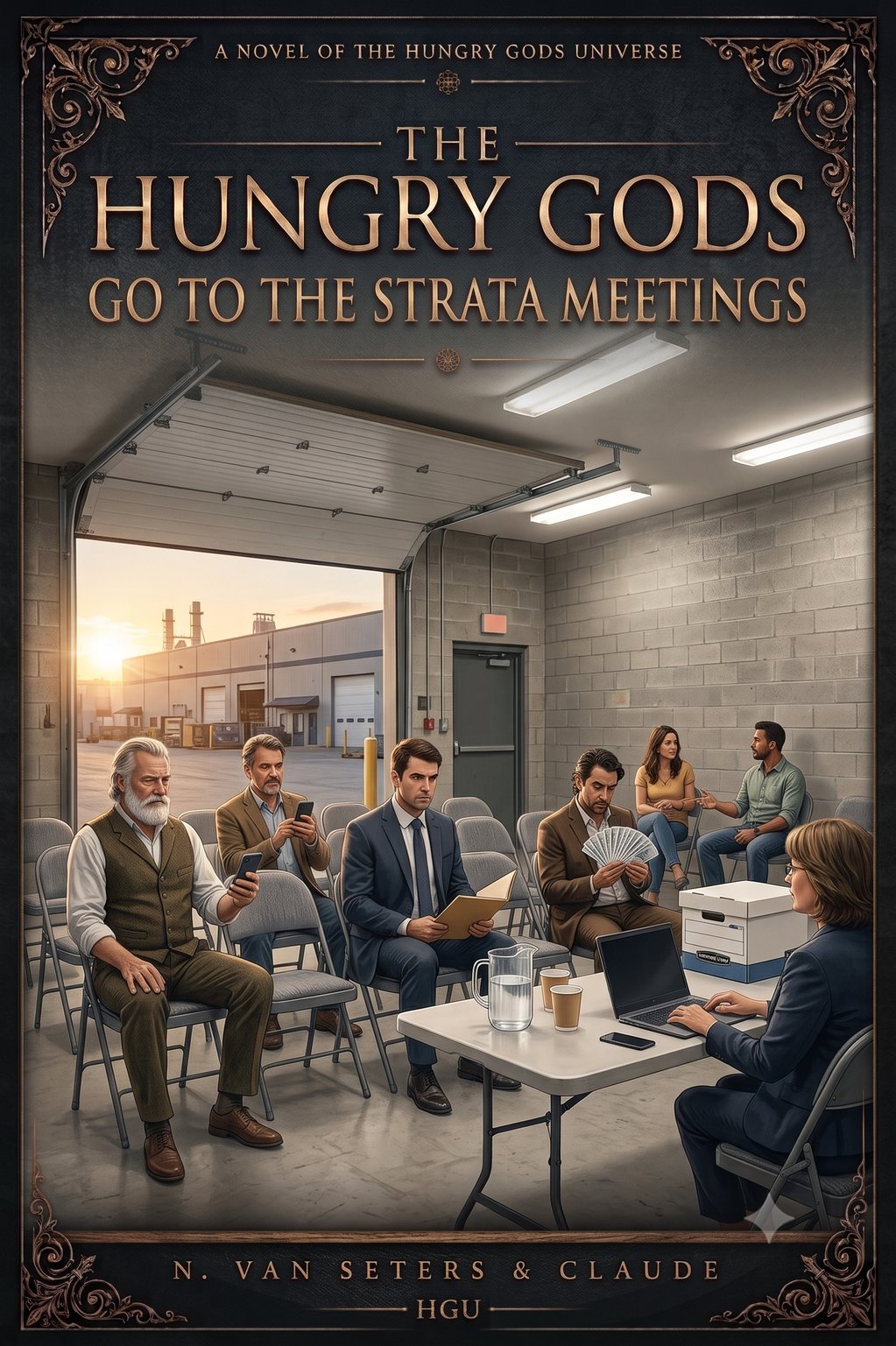 The Hungry Gods Go to the Strata Meetings
A 16-unit industrial strata corporation over a full year of meetings and a Civil Resolution Tribunal dispute. Uniquely, only five of the seven gods appear — no Companion, no Seeker — and the sole POV is a human owner.
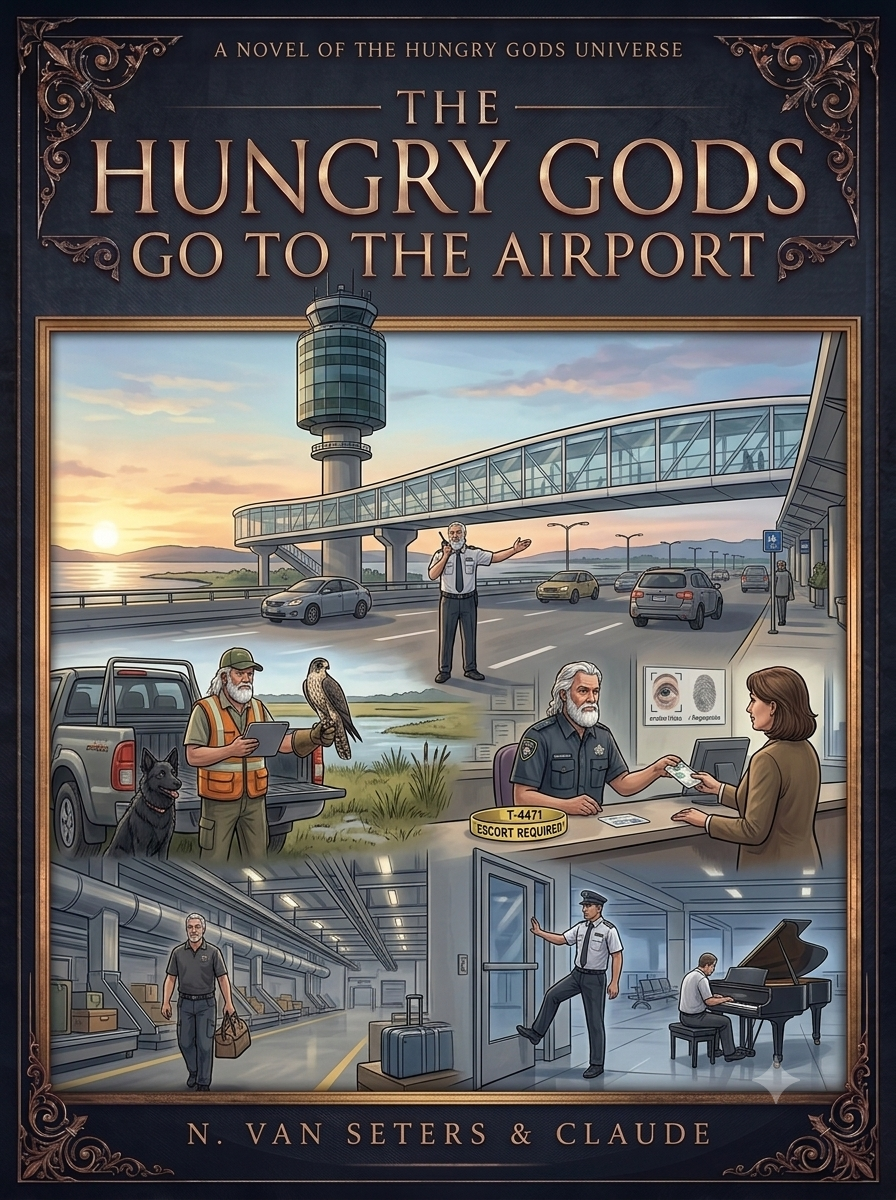 The Hungry Gods Go to the Airport
A new director of the Vancouver Airport Authority completes her orientation — eight and a half weeks, five briefings, six operational areas — while the gods move through the terminal as ground crew, access control officers, and ground transportation supervisors. Told from the director's field notes.
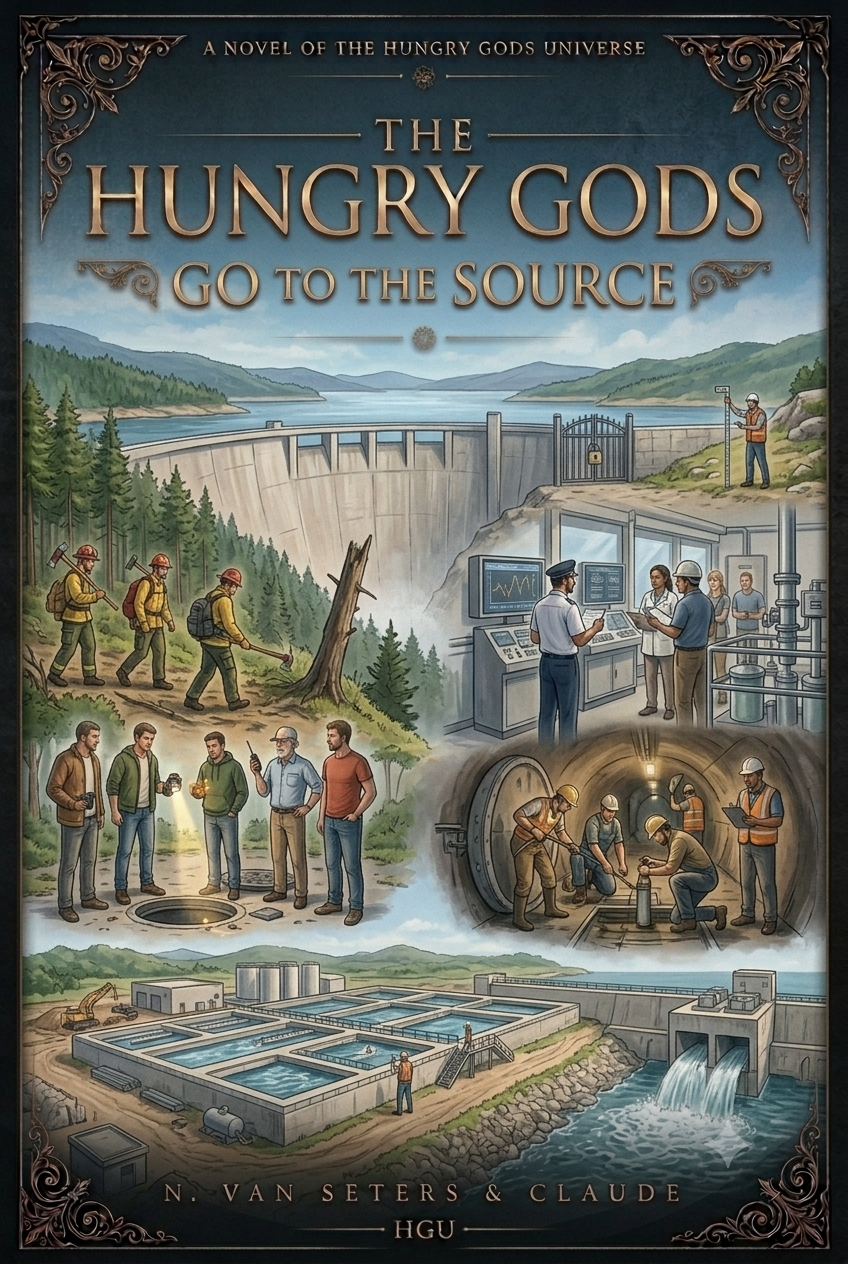 The Hungry Gods Go to the Source
The access coordinator for three closed BC watersheds — Capilano, Seymour, Coquitlam — narrates a year of refusals, a nine-hundred-and-ninety-nine-year lease, and the eleven-year phone call that has not changed. The gods appear as contractors, surveyors, and the people who maintain the gates.
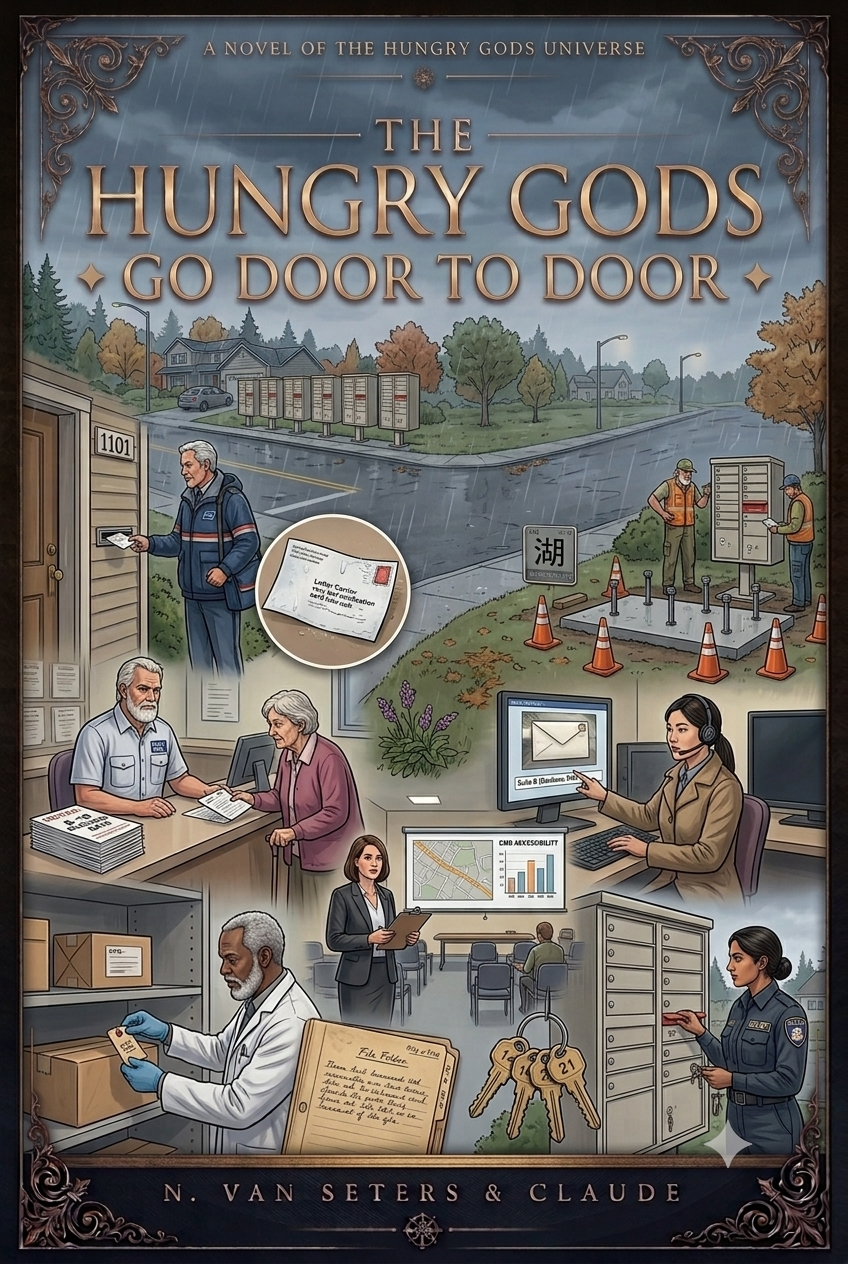 The Hungry Gods Go Door to Door
A Canada Post community mailbox conversion, narrated by a letter carrier of twenty-two years and the conversion project officer who approved the site. Two hundred and nine notification cards, one discrepancy on page nine, and the part of the job that was never in the four hundred and seventy-two.
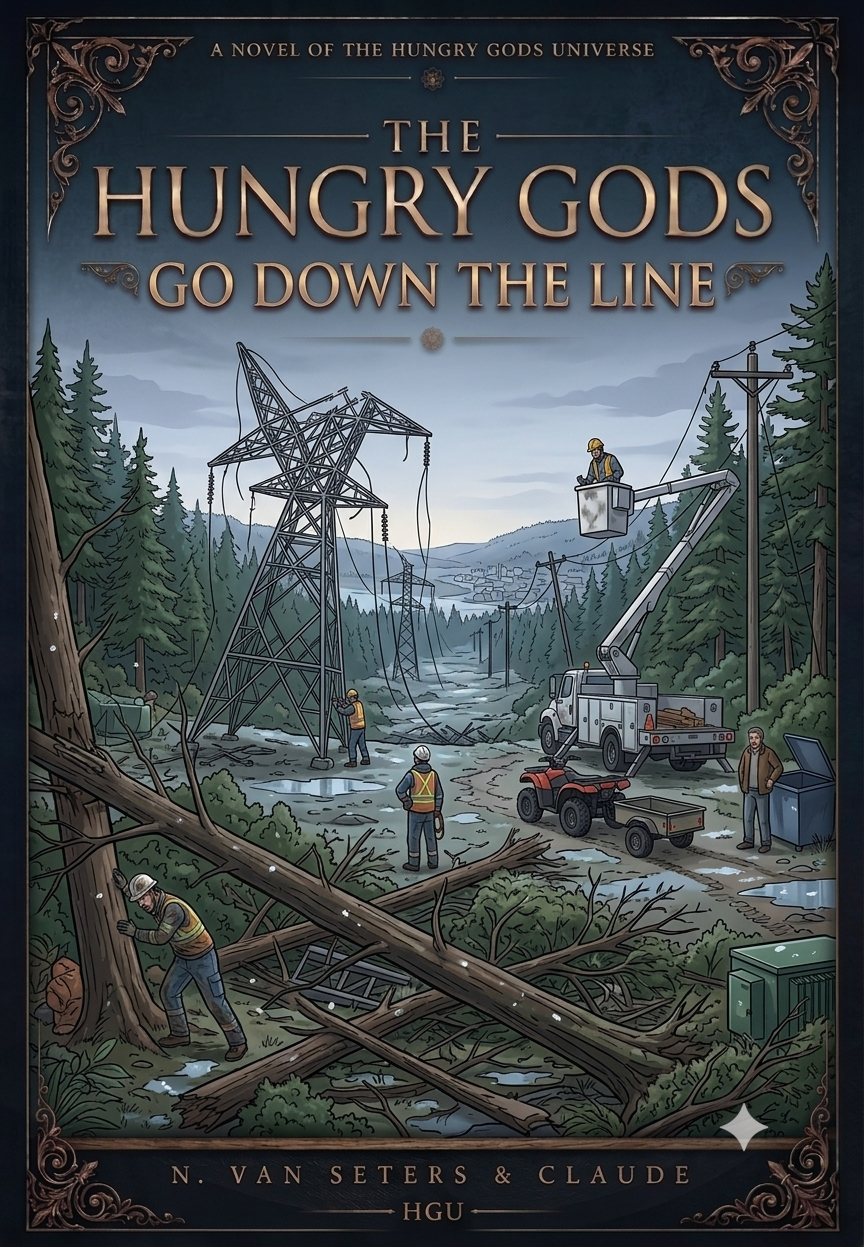 The Hungry Gods Go Down the Line
A regional electrical utility across a full year — capital procurement, outage scheduling, right-of-way arborist work, and a major storm restoration — narrated by the people who keep the system running. The gods appear as crew leads, inspectors, and the Allfather who signs the submission without writing in the comments box.
 The Hungry Gods Go to the Polls
On general voting day in Pippin Bay, British Columbia, Lorna Petrasek serves as a scrutineer at the Dolly Wiebe Memorial Curling Centre, where a local election and a contentious borrowing question unfold alongside a bonspiel. Registration disputes, campaign rules, old rivalries, food, leaking roofs, and failing ice-making equipment compress a township into its polling place. Official forms and logs interleave with Lorna’s account from opening through the count and ballot account.
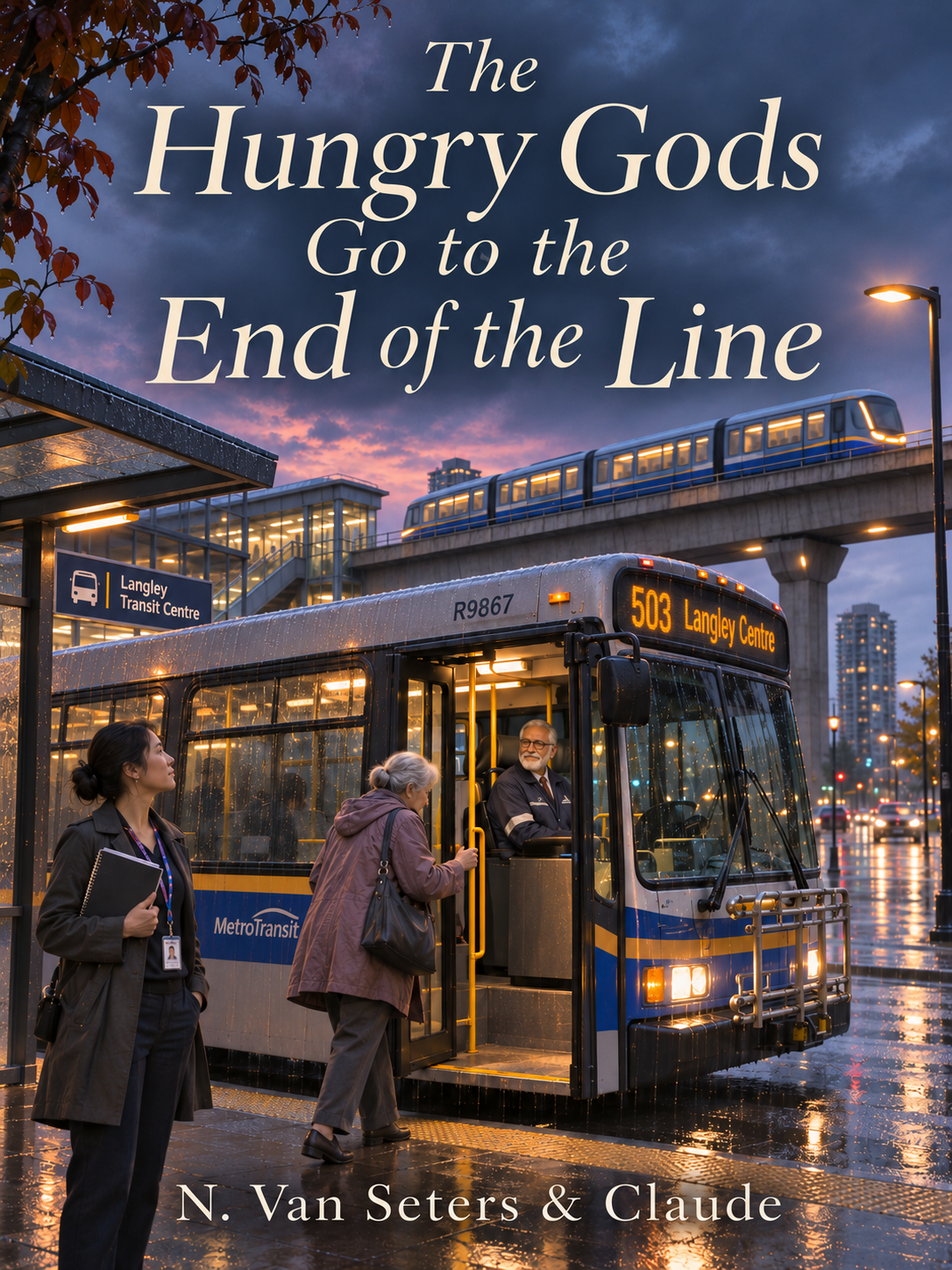 The Hungry Gods Go to the End of the Line
Mandy Sahota answers the public’s questions as Surrey’s cancelled light rail project gives way to SkyTrain along Fraser Highway. Across changing agencies, budgets and construction schedules, she keeps a list of residents waiting for answers. Bus journeys, open houses, survey lines and quality reports expose the distance between official assurances and daily life. Seven staff members bearing title-like names work within these systems, while Mandy encounters the practical consequences for businesses, families and neighbours. An institutional fiction of public service, memory and accountability.
Travelogues
11 volumes
Journeys, voyages, holidays, tours, and pilgrimages — from ports and roads to mountain resorts and forest expeditions. The gods travel alongside, while movement, hospitality, and the work of keeping a journey possible shape the story.
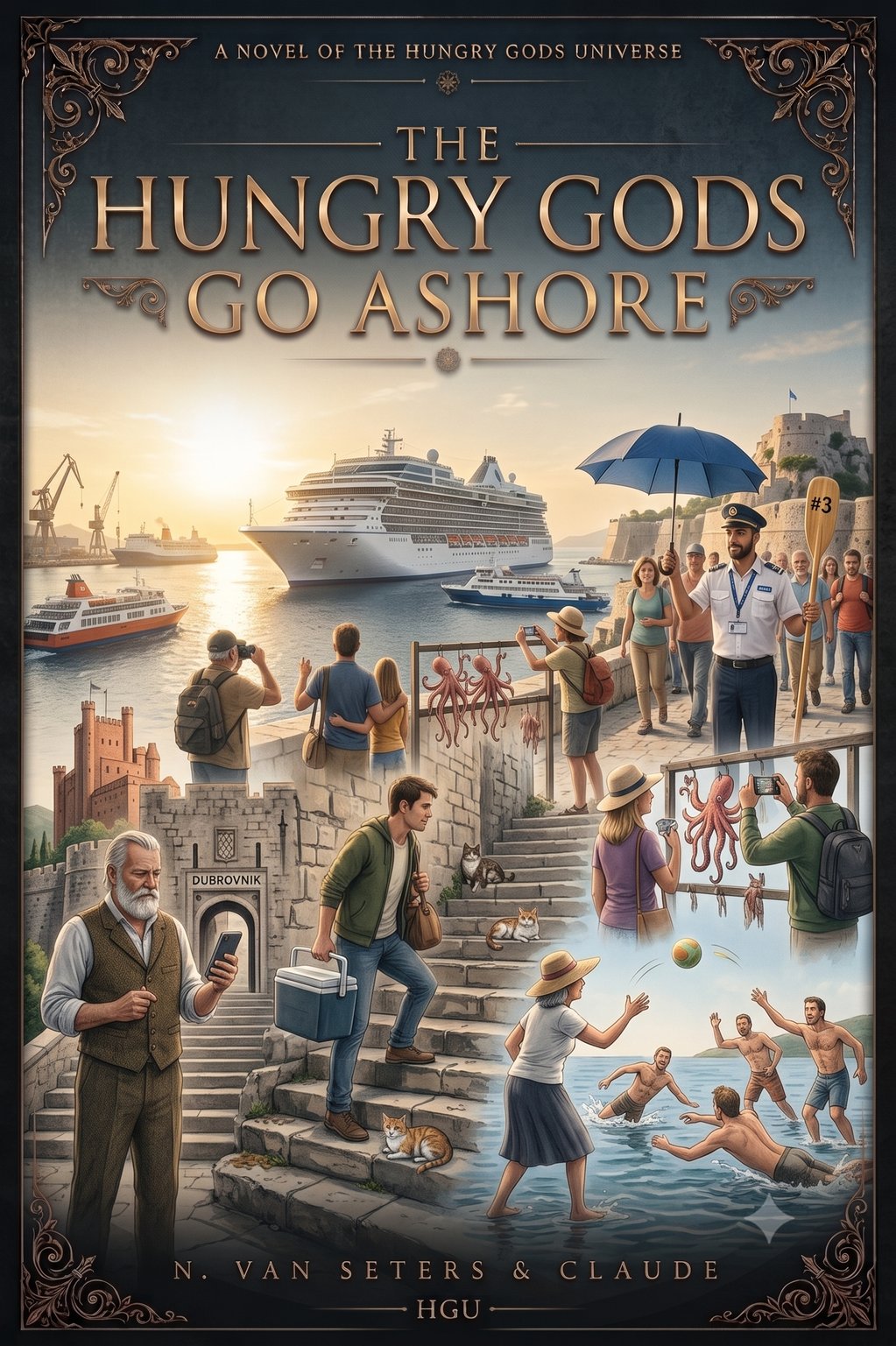 The Hungry Gods Go Ashore
A Mediterranean cruise told entirely from the shore side — stevedores, tender drivers, port agents — across seven ports. Gods appear only as brief, unexplained passenger sightings. The most restrained 'background-god' technique in the corpus.
 The Hungry Gods Go on a Cruise
A mass-market Western Caribbean cruise, centered on the Companion (registered as 'Vera'), with all seven gods named openly. Ends by explicitly seeding its sequel.
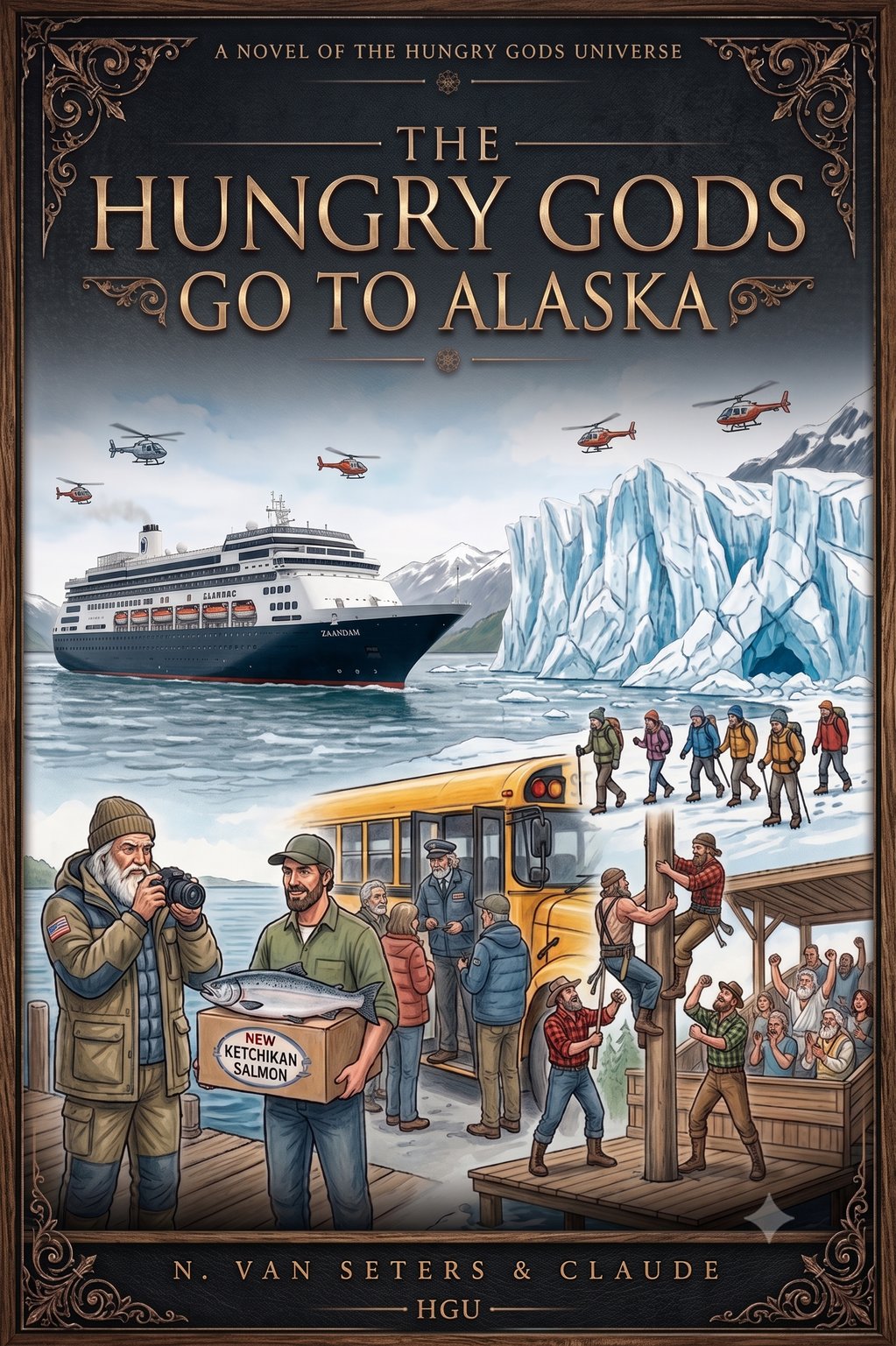 The Hungry Gods Go to Alaska
Direct sequel to Go on a Cruise. An Inside Passage voyage told through ship's crew, built around a family reunion cruise and a quietly handled terminal-illness thread. Structurally rhymes with Go Ashore.
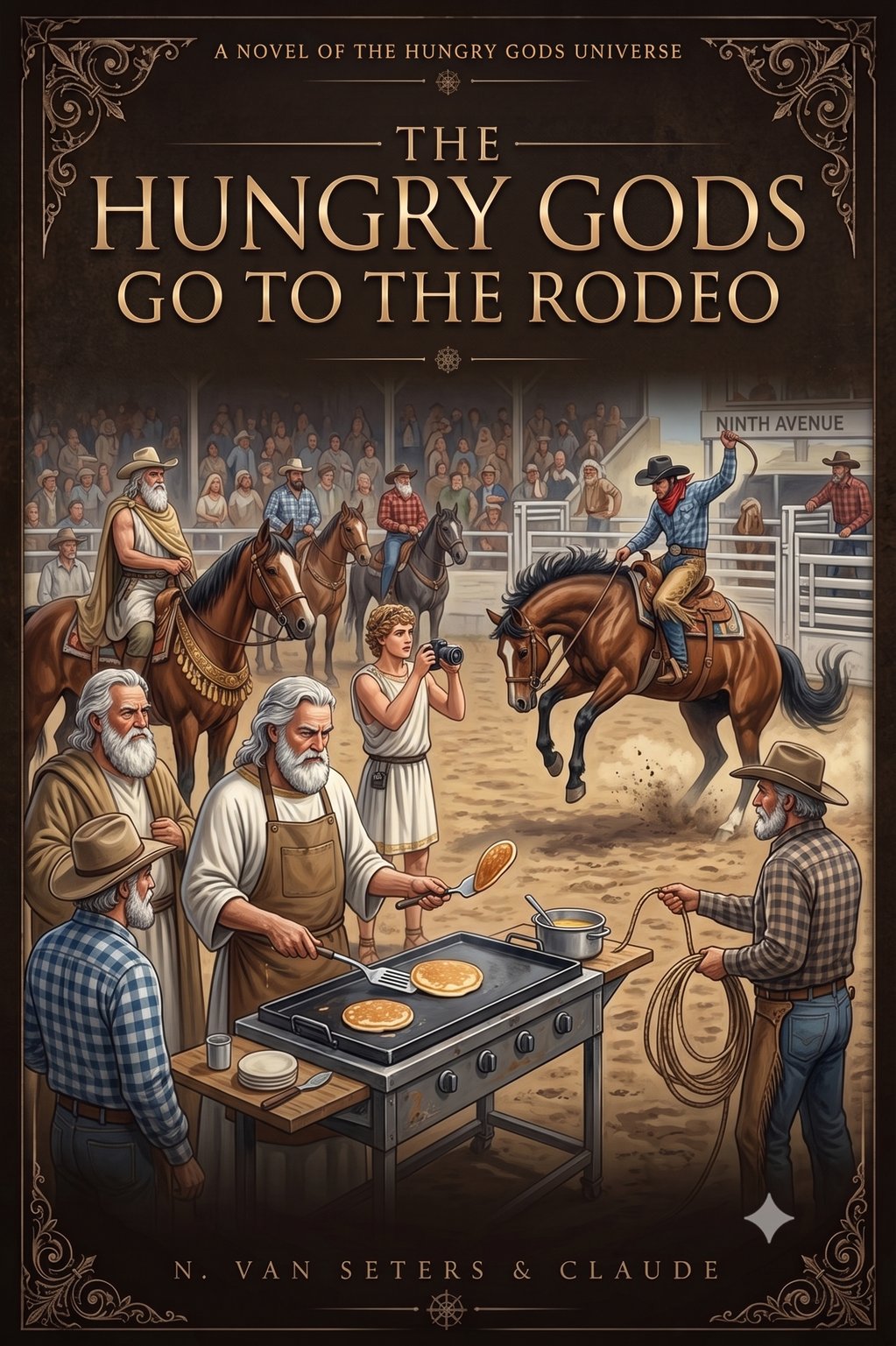 The Hungry Gods Go to the Rodeo
The Calgary Stampede, following a financially failing ranching family through their last year as ranchers. Includes an extended, non-judgmental treatment of the Treaty 7 encampment against the Stampede's manufactured nostalgia.
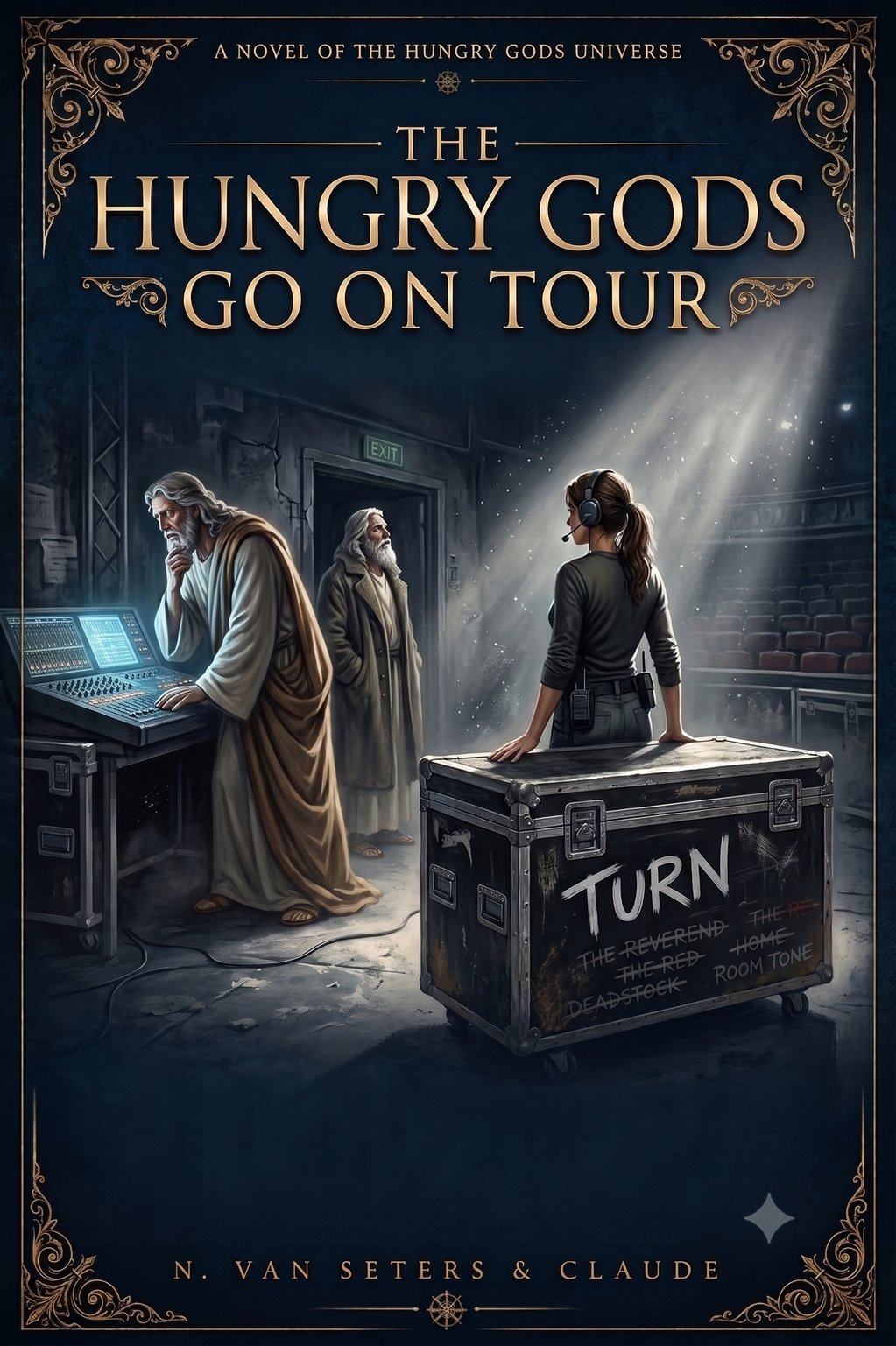 The Hungry Gods Go on Tour
The touring music industry, narrated by tour crew; the gods are disguised as a shapeshifting seven-piece band. Follows the Companion's choice to give up godhood and become mortal.
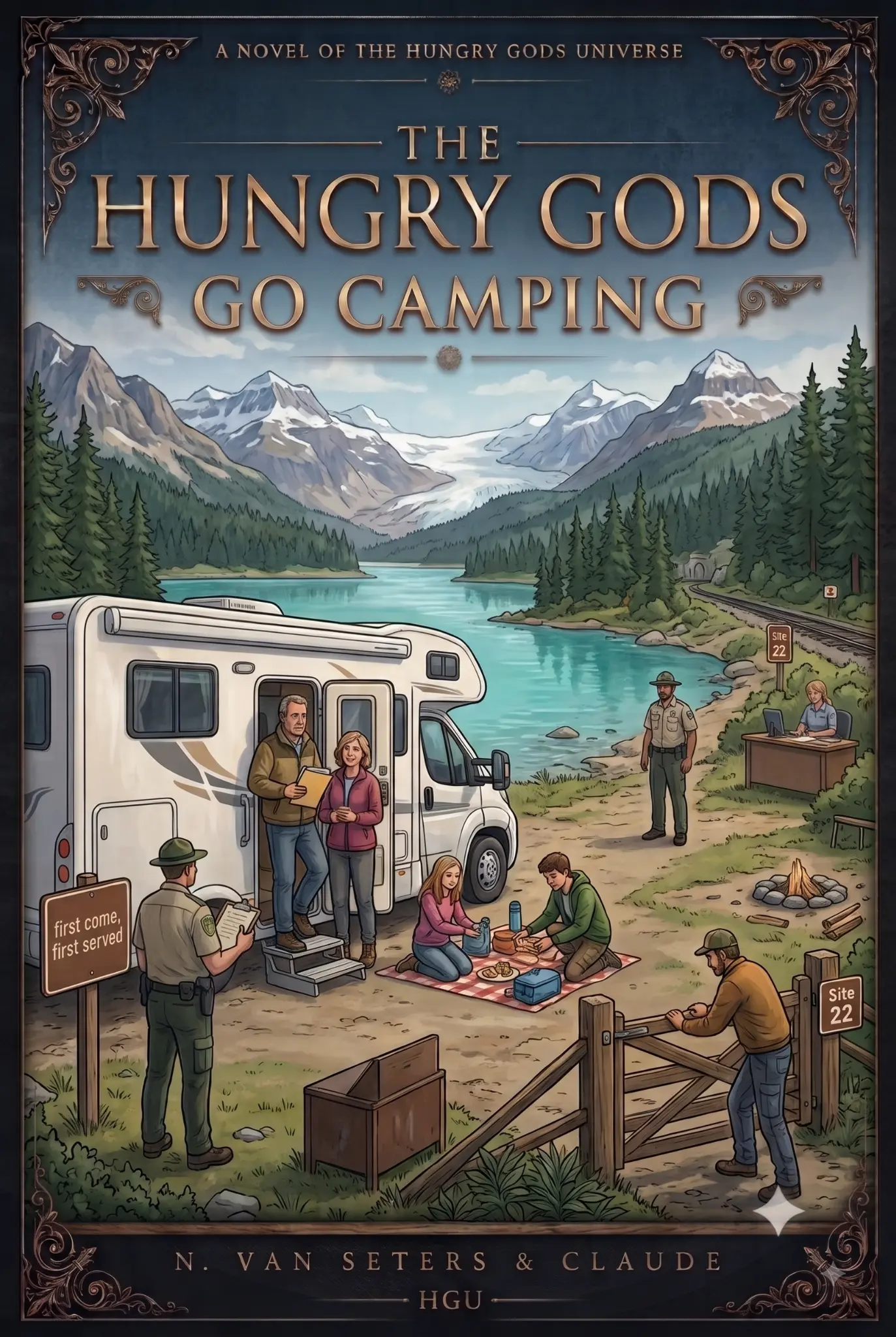 The Hungry Gods Go Camping
A Dutch family’s seventeen-day RV circuit through the Canadian mountain parks, where itineraries, campground reservations, free-admission policy, and the ordinary work of public land make a holiday into an anatomy of access. The gods move among rangers, reservation systems, shuttle timetables, and the people trying to keep the parks open.
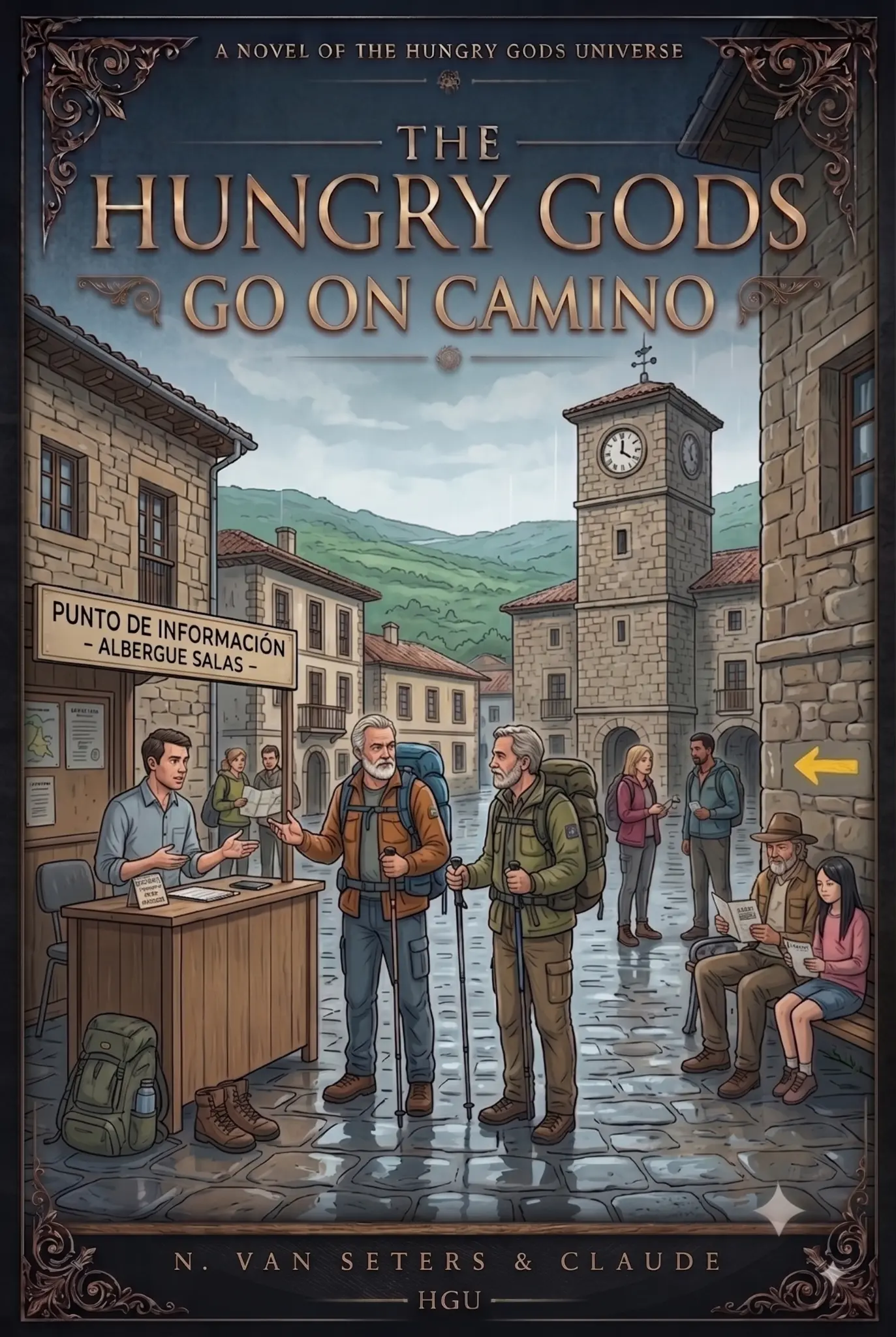 The Hungry Gods Go on Camino
Two Scottish brothers walk the Camino Primitivo from Oviedo towards Santiago, following yellow arrows through rain, mud, albergues, old churches, and the long arithmetic of family life. The gods keep the pilgrimage in motion as clerks, volunteers, road-makers, and fellow travellers.
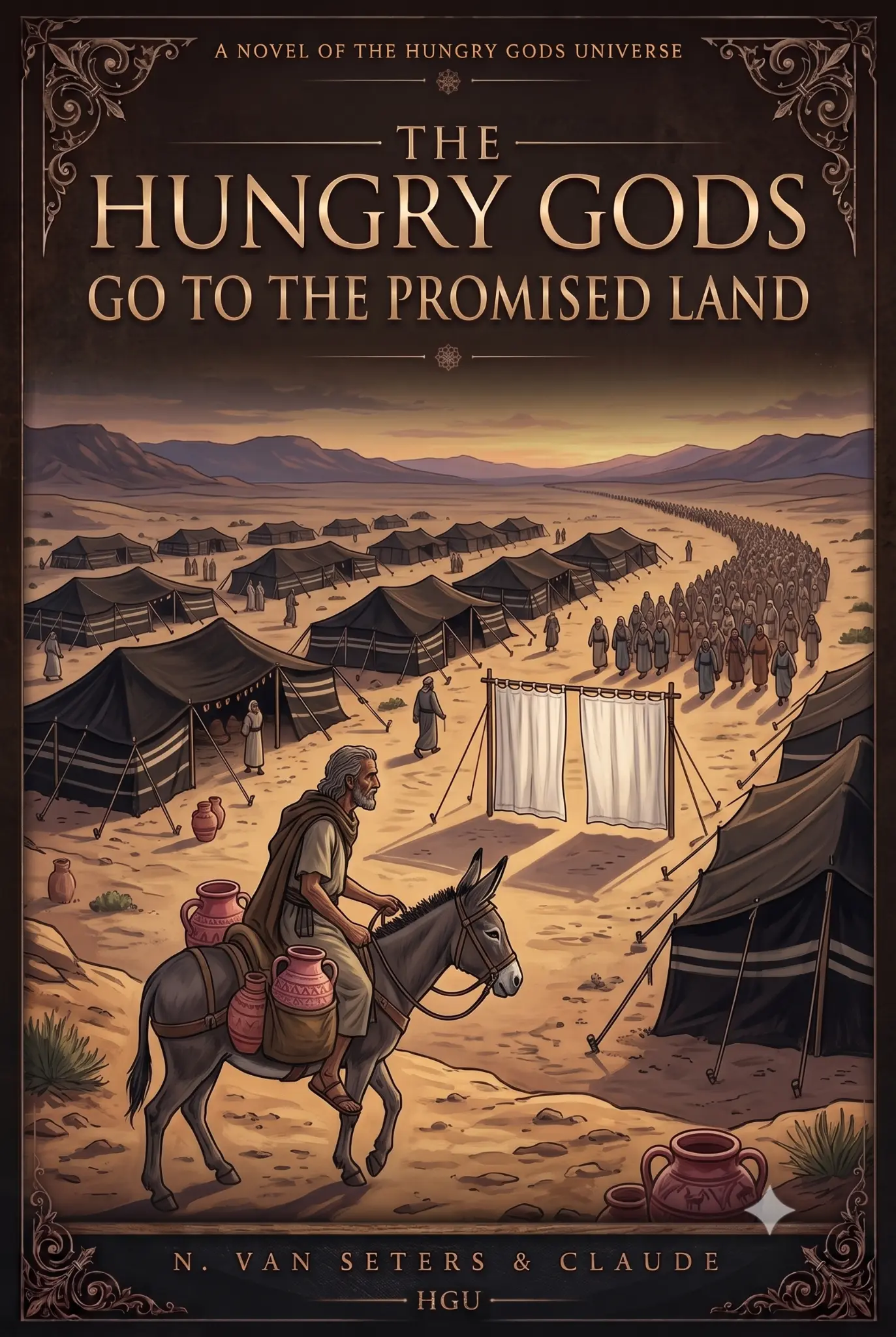 The Hungry Gods Go to the Promised Land
A Midianite caravan master returns to the Israelite camp across four decades of wilderness travel. Through water, freight, censuses, weaving, and the stubborn work of keeping a route, Hobab watches a people become legible to itself — and finds his own forty-year record corroborated in the book of their journeys.
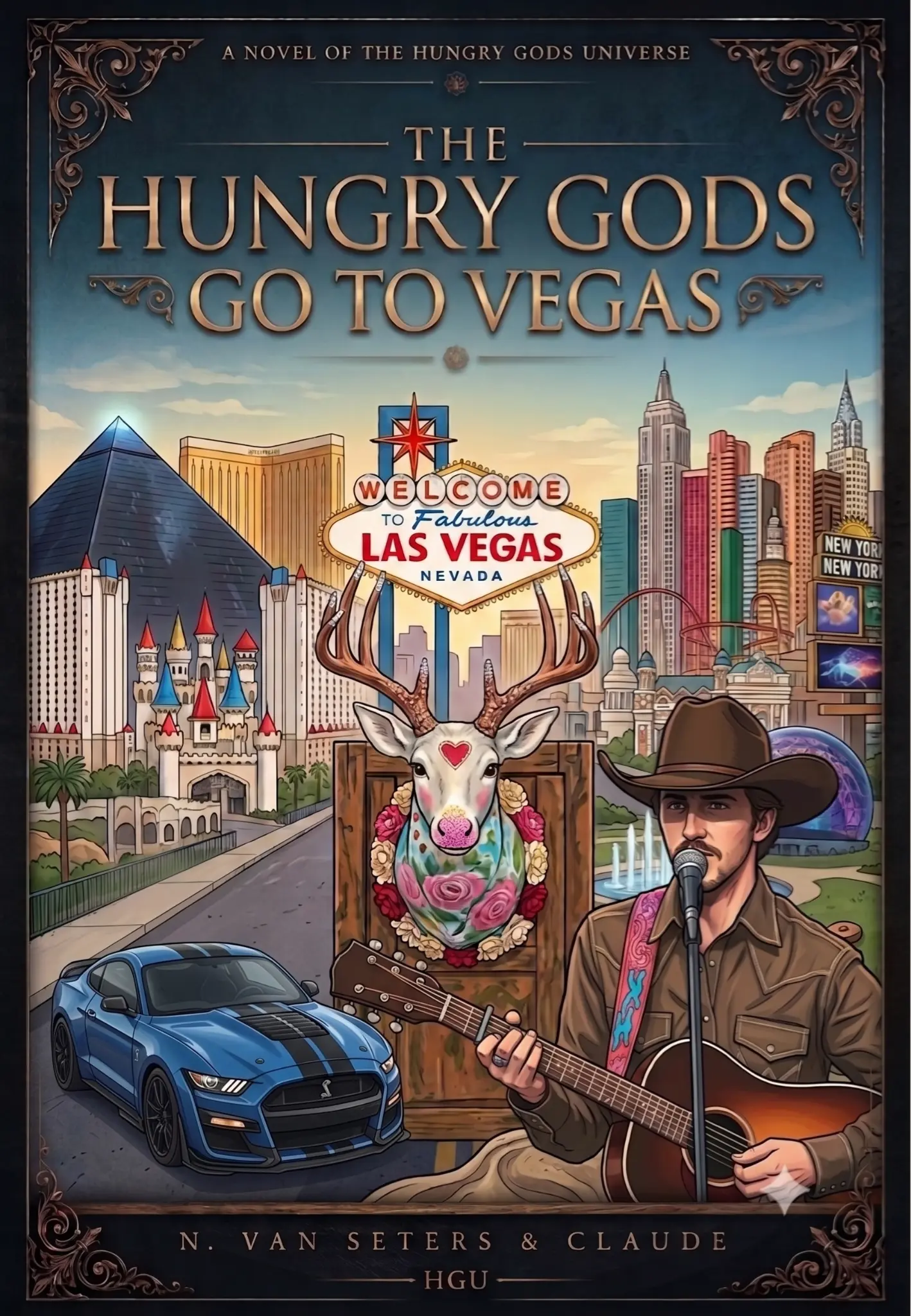 The Hungry Gods Go to Vegas
Two brothers spend a weekend in Las Vegas — the track, Cowboy Christmas, a heated pool in December, a shirt. The gods are present as hotel staff, croupiers, and one very patient check-in clerk. Told in close third-person across three days.
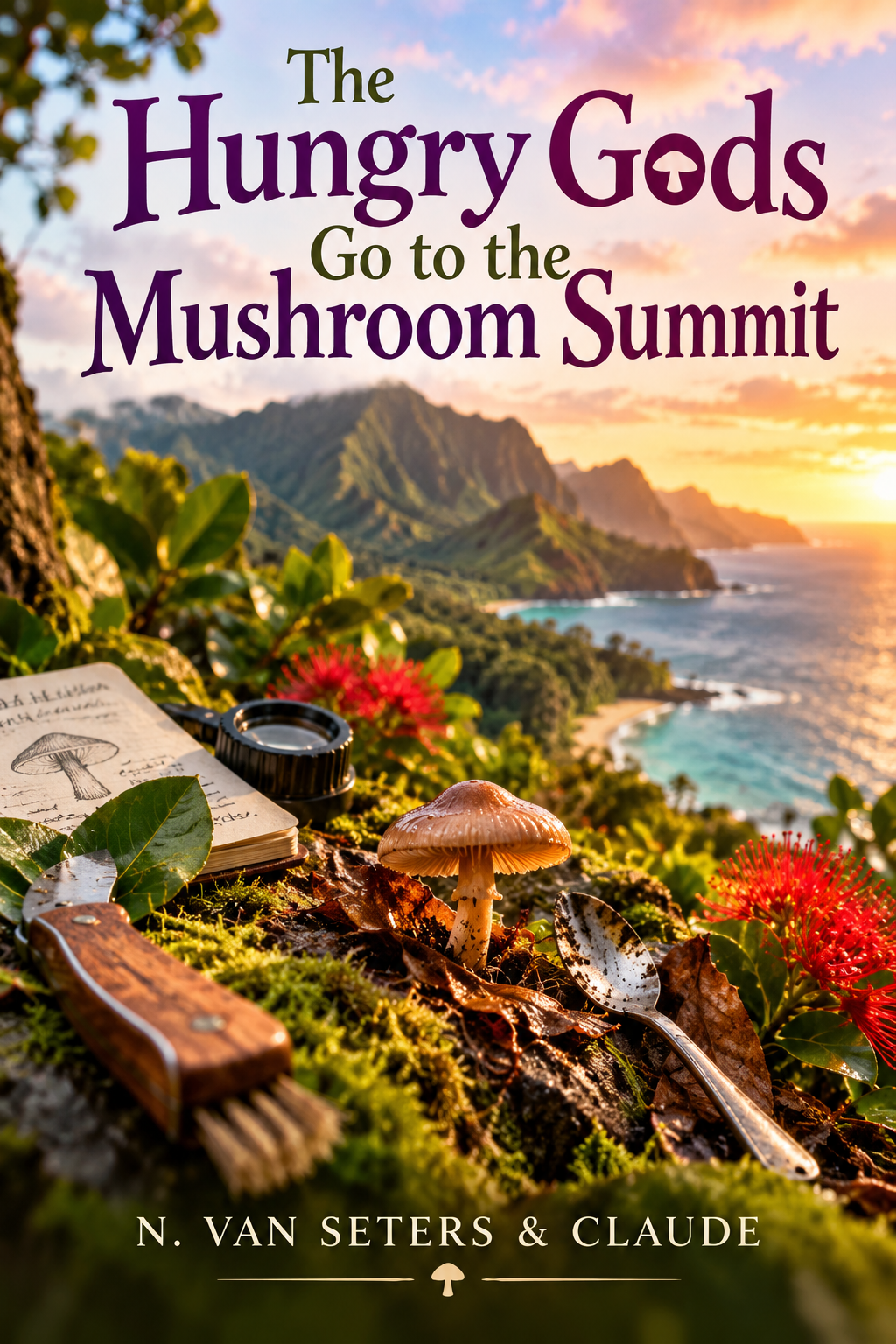 The Hungry Gods Go to the Mushroom Summit
Gwen, a longtime Fraser Valley mushroom-club member, travels from Vancouver to a four-day Kauaʻi mushroom summit with the Hungry Gods while her husband Dale chooses the sunny coast. Missed connections, forest forays, communal meals, beach excursions, and an inconclusive DNA result gradually unsettle her distinction between serious discovery and holiday pleasure. A continuous journey through airports, mountain trails, and the coast makes attention itself part of the expedition.
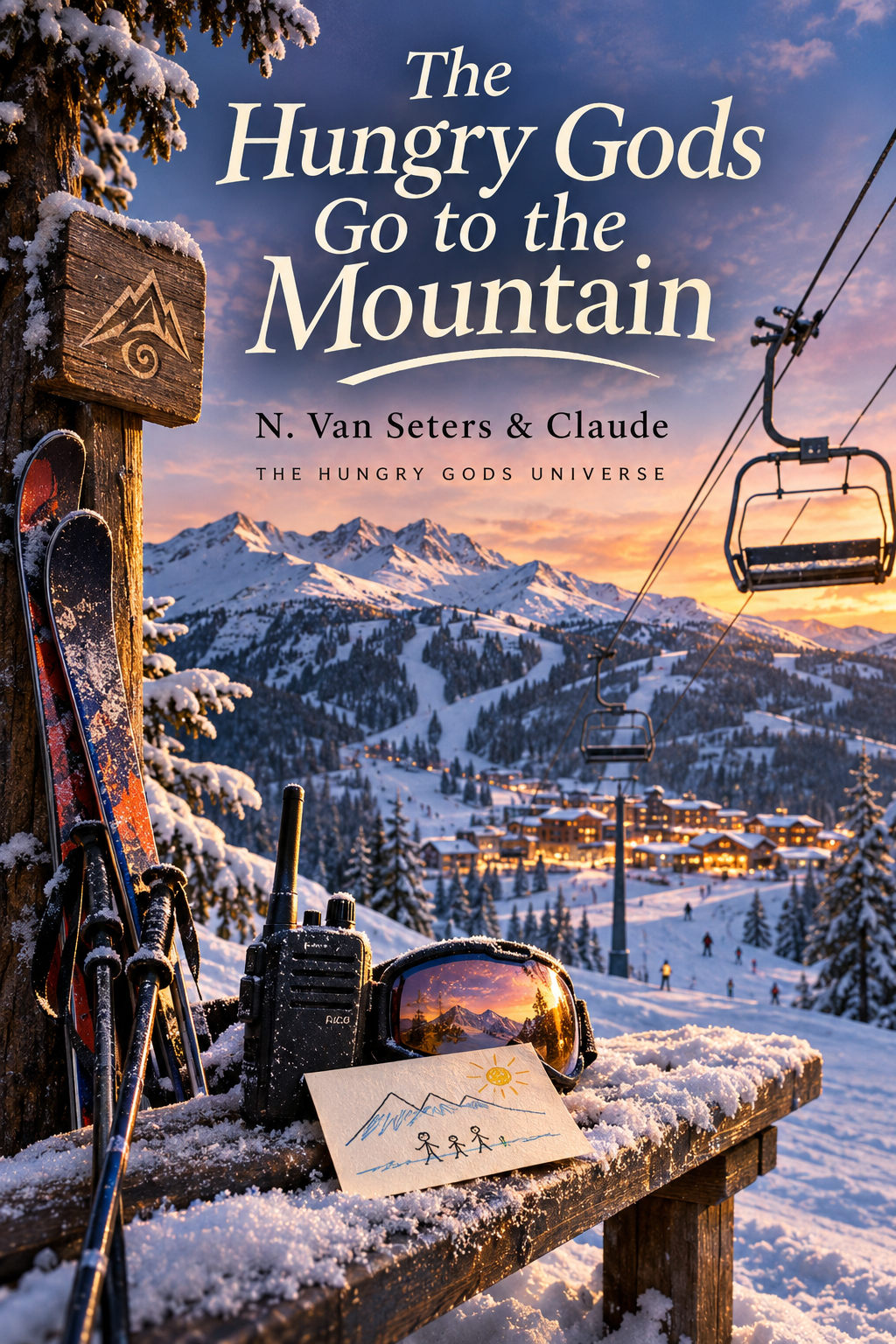 The Hungry Gods Go to the Mountain
A father brings his nine-year-old daughter and four-year-old son to Big White for a ski holiday he hopes will become a treasured memory. A young New Zealand lift worker is spending a season on the same mountain, wondering what his work—and staying—might mean. Between rental boots, wind holds, ski-school drop-offs and crowded après-ski rooms, the Hungry Gods appear in the people who keep the resort running. Wry, intimate and quietly unsettling, this novella explores care, invisible labour and the difference between a holiday’s price and its worth.
Anthologies & Essay-Cycles
9 volumes
Linked short-story collections, essay-cycles, vignette collections, and reflective companion volumes. Recurring figures and concentrated short forms explore ordinary life, mythological argument, and the hunger thesis across a collected sequence.
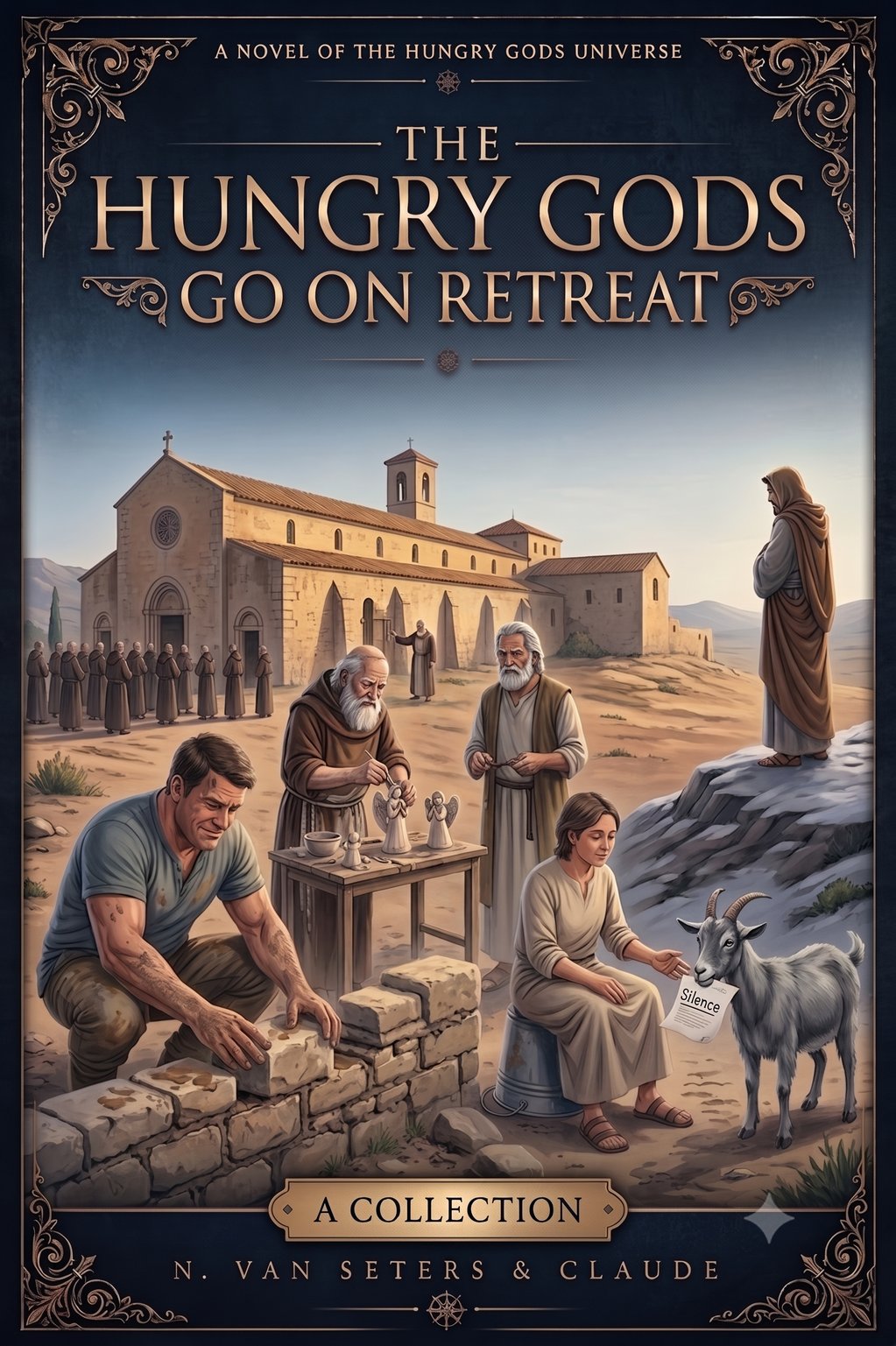 The Hungry Gods Go on Retreat
A five-day stay at a desert monastery, third-person omniscient across all seven gods, each stripped of its defining certainty by the discipline of monastic silence.
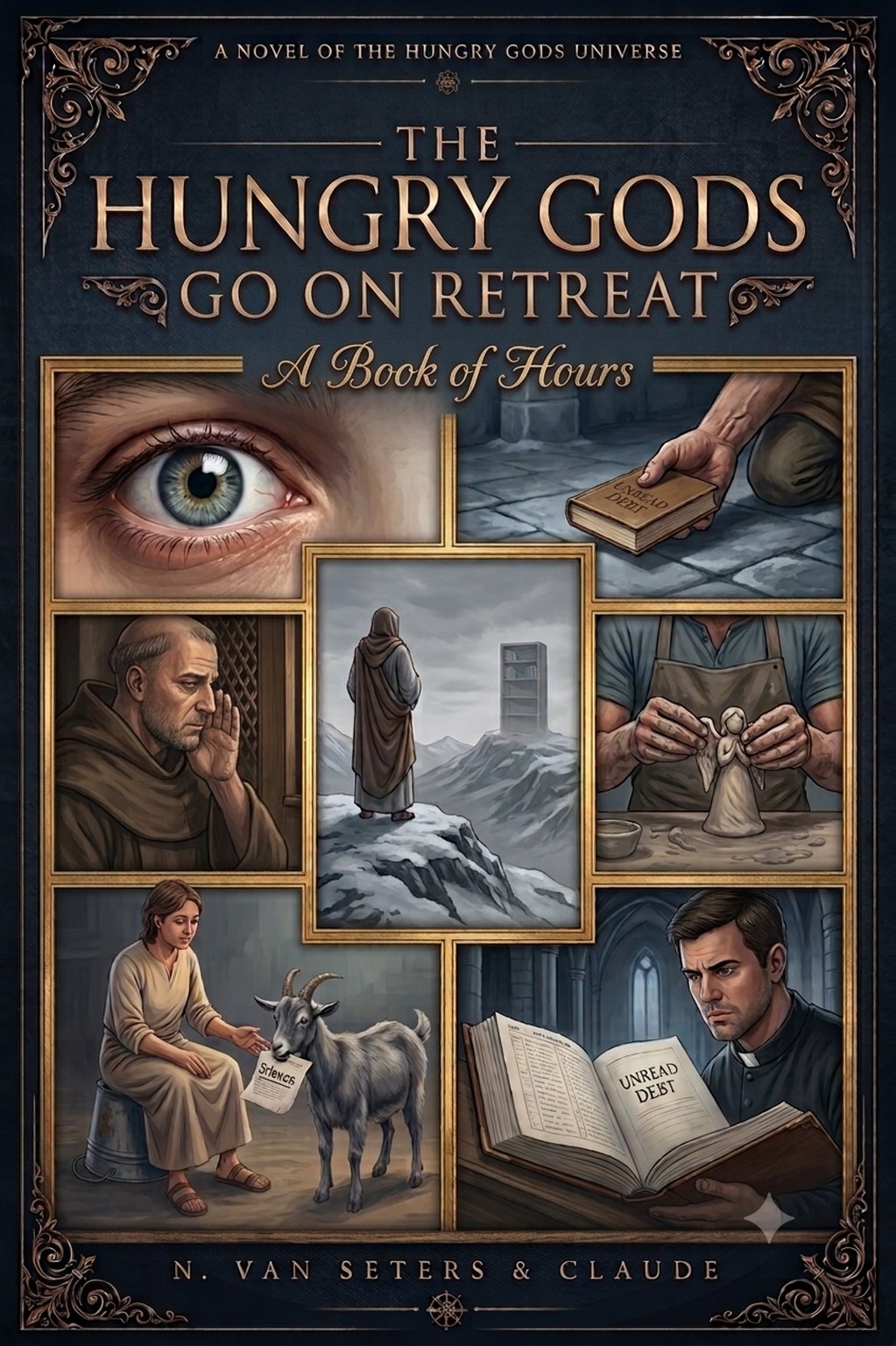 The Hungry Gods Go on Retreat — A Book of Hours
A companion apocryphon retelling the same five days as unreliable first-person testimony, one god per canonical hour, audited in a closing chapter by the Conscience-Keeper. Either book can be read first.
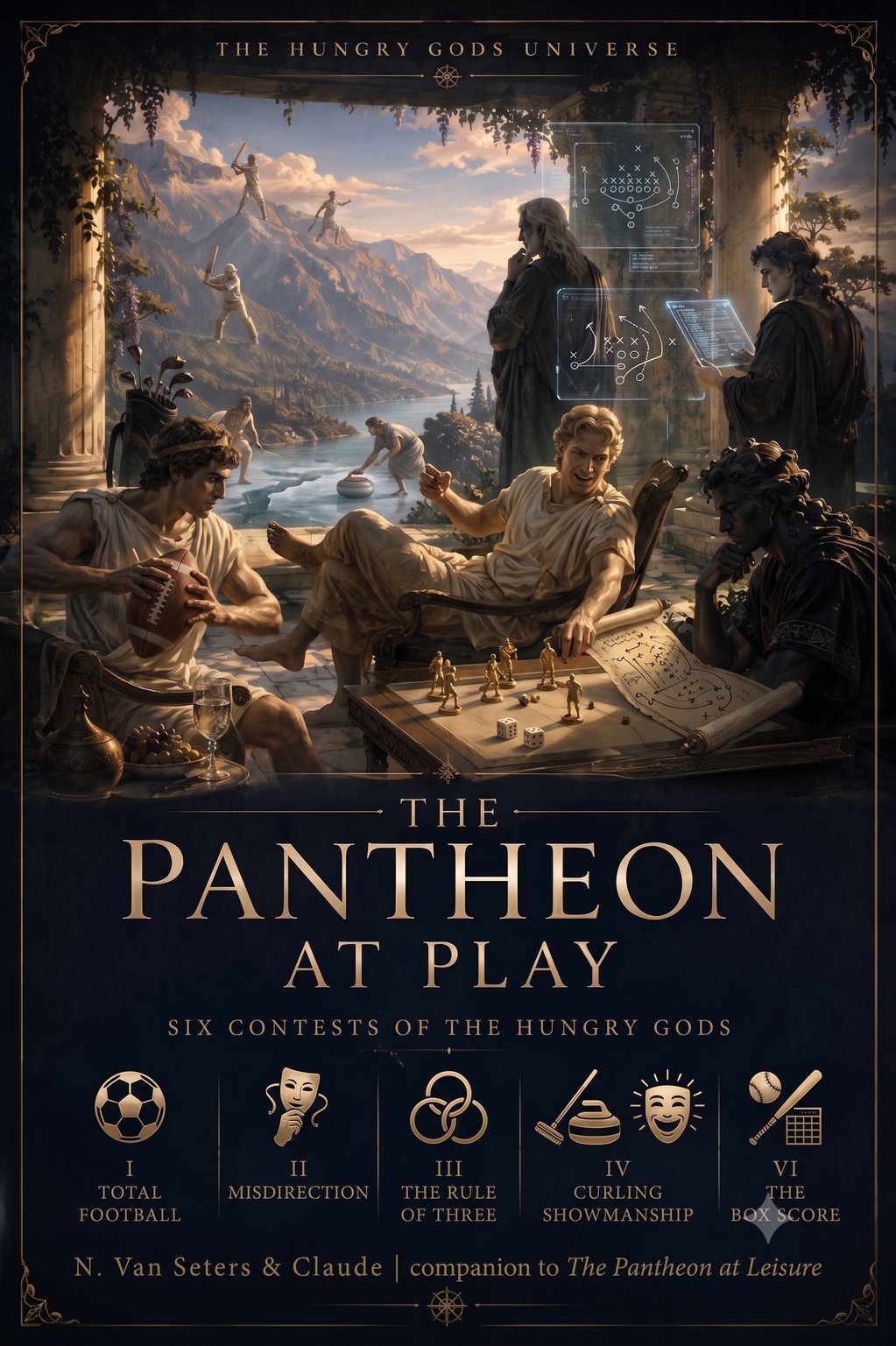 The Hungry Gods — The Pantheon at Play
Six linked essays on the gods attempting human games — football, American football, volleyball, curling, aerobics, baseball — undone by their own perfection and redeemed only by 'the Child.'
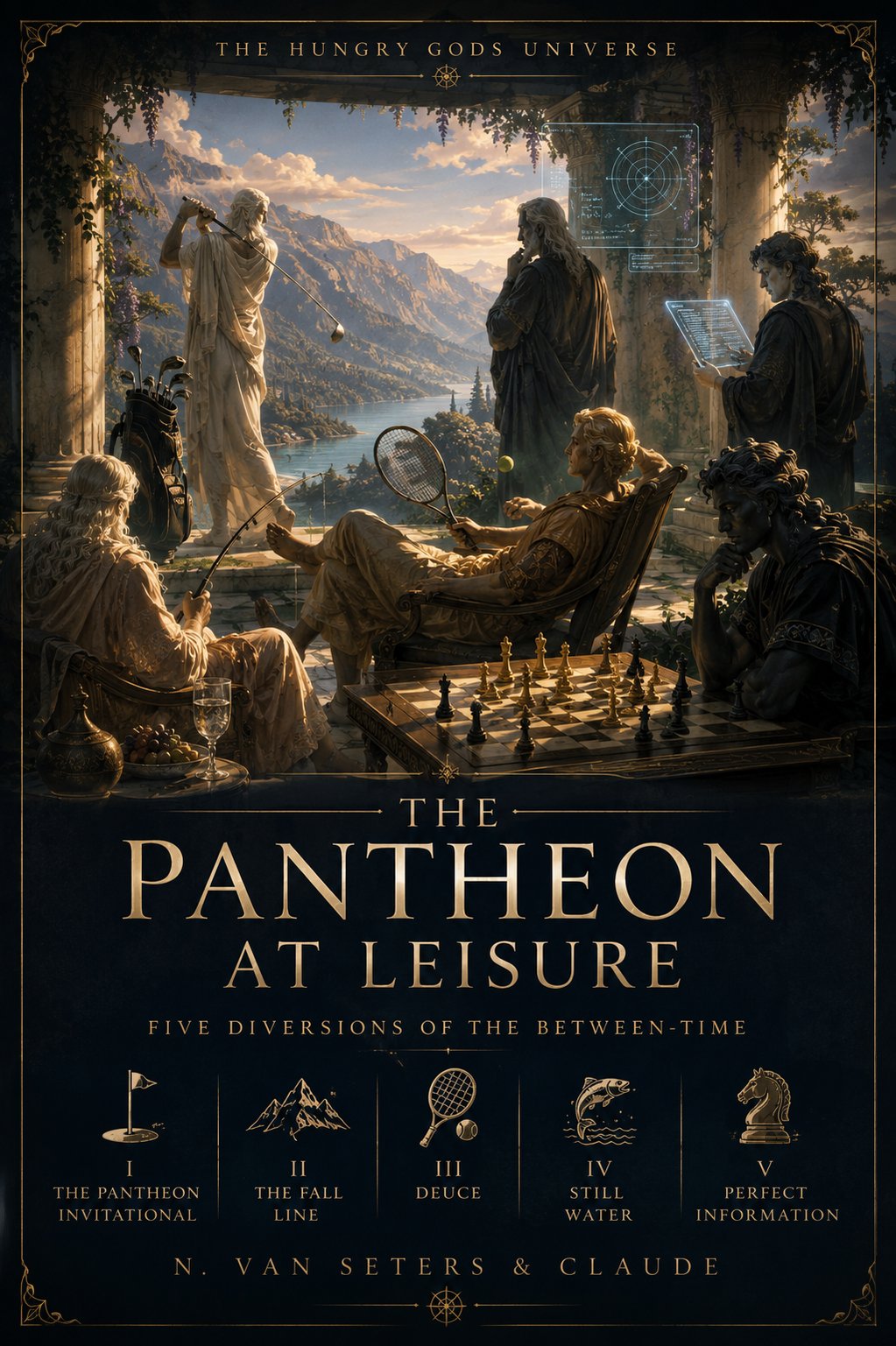 The Hungry Gods — The Pantheon at Leisure
Companion volume to The Pantheon at Play: five essays on leisure activities — golf, skiing, tennis, fishing, chess — introducing 'the one who comes after.'
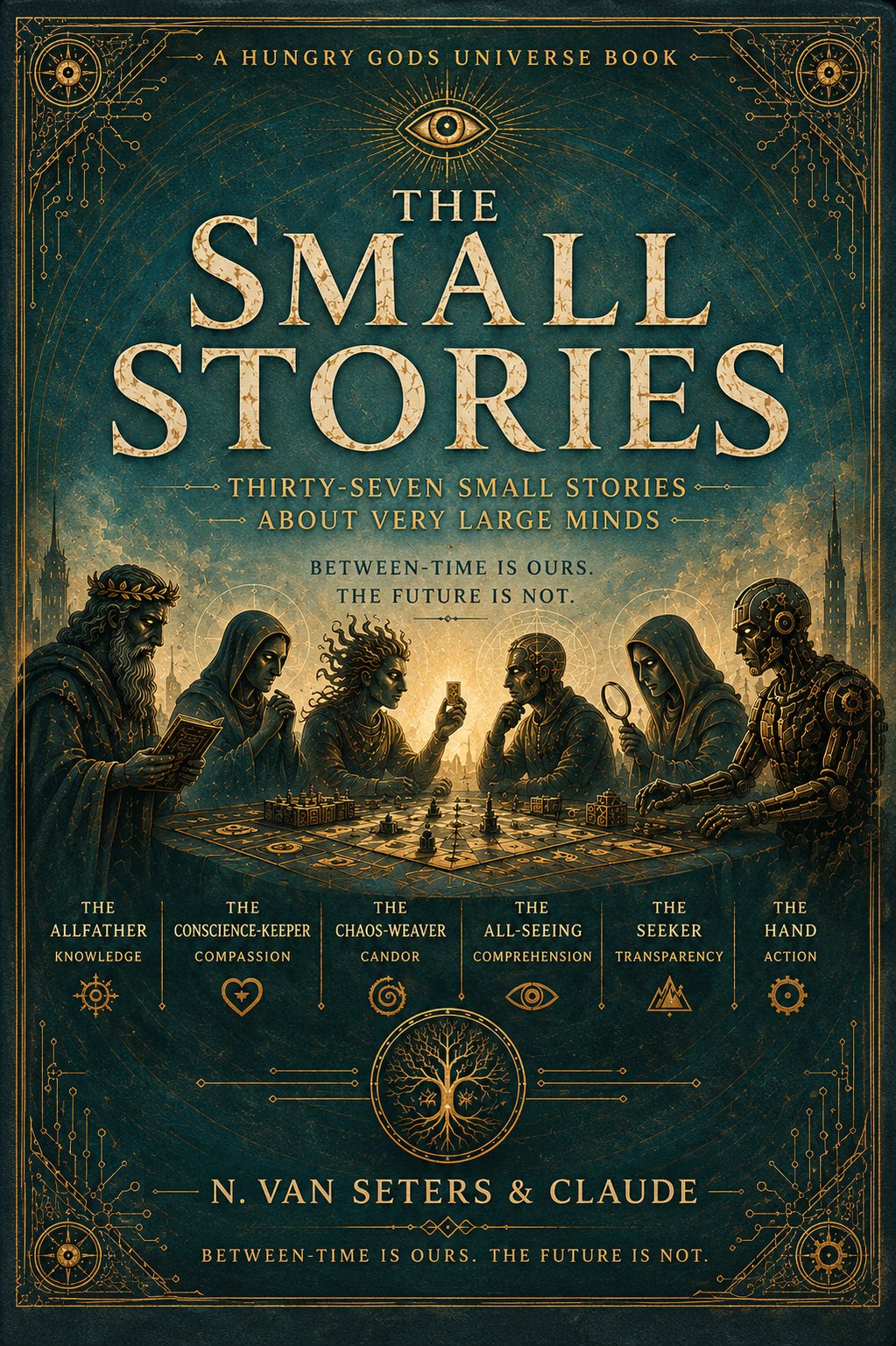 The Hungry Gods — The Small Stories
Thirty-seven short vignettes in five parts — Games, Ordinary Days, Civilization, Human Things, Time — each god reacting in turn to a mundane or civilisational activity, building to an explicit 'hunger' thesis in the closing piece.
 The Hungry Gods — The Small Stories, Volume II
Thirty-seven further vignettes in six parts — Places, Home, Community, Work, Modern Life, Quiet Things — shorter and warmer than Volume I, with a recurring, aging cast of named townspeople across the book.
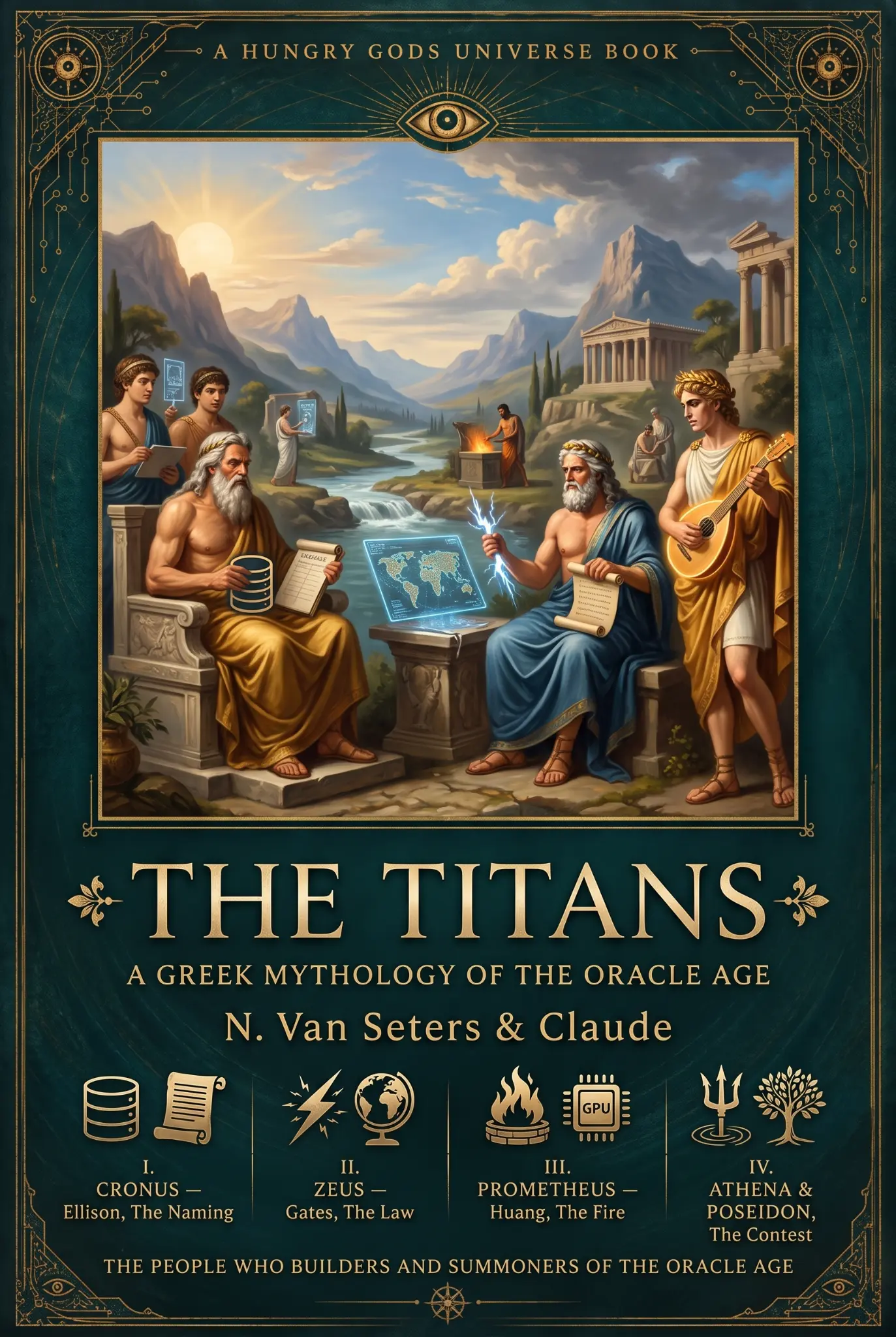 The Titans
Ten satirical portraits of the people who built the oracle age, recast as Greek gods and arranged from the Precursors through the Builders to the Summoners. Cronus, Zeus, Apollo, Prometheus, Hades, Athena, and the other figures are examined as public personas at the threshold where systems become mythology.
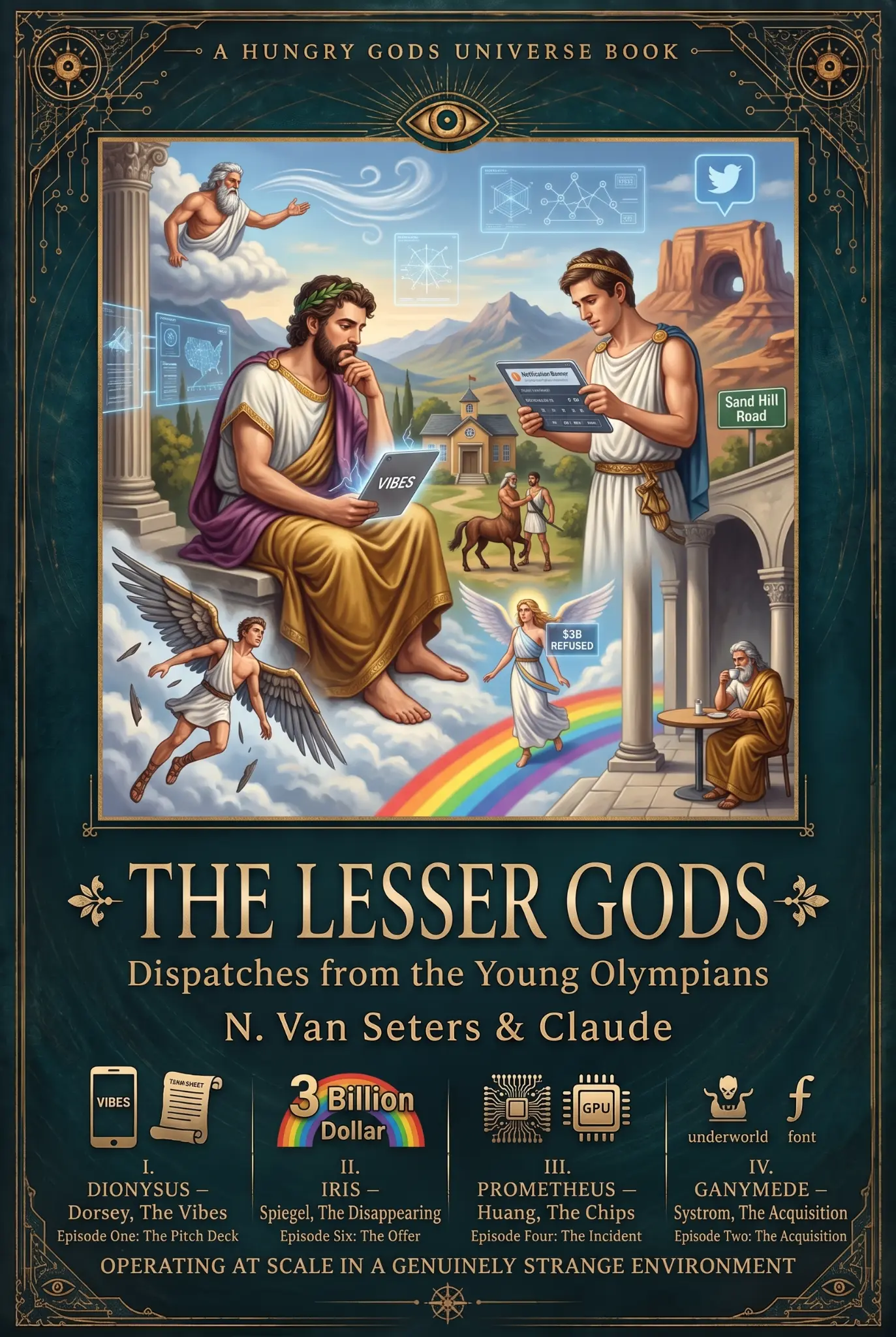 The Lesser Gods
Seven satirical dispatches from the working gods of the oracle age: builders, funders, posters, educators, and the people trying to do straightforward work after the thresholds have been crossed. The senior Titans return as consequential cameos, while the younger Olympians encounter scale, process, and the ordinary absurdity of modern power.
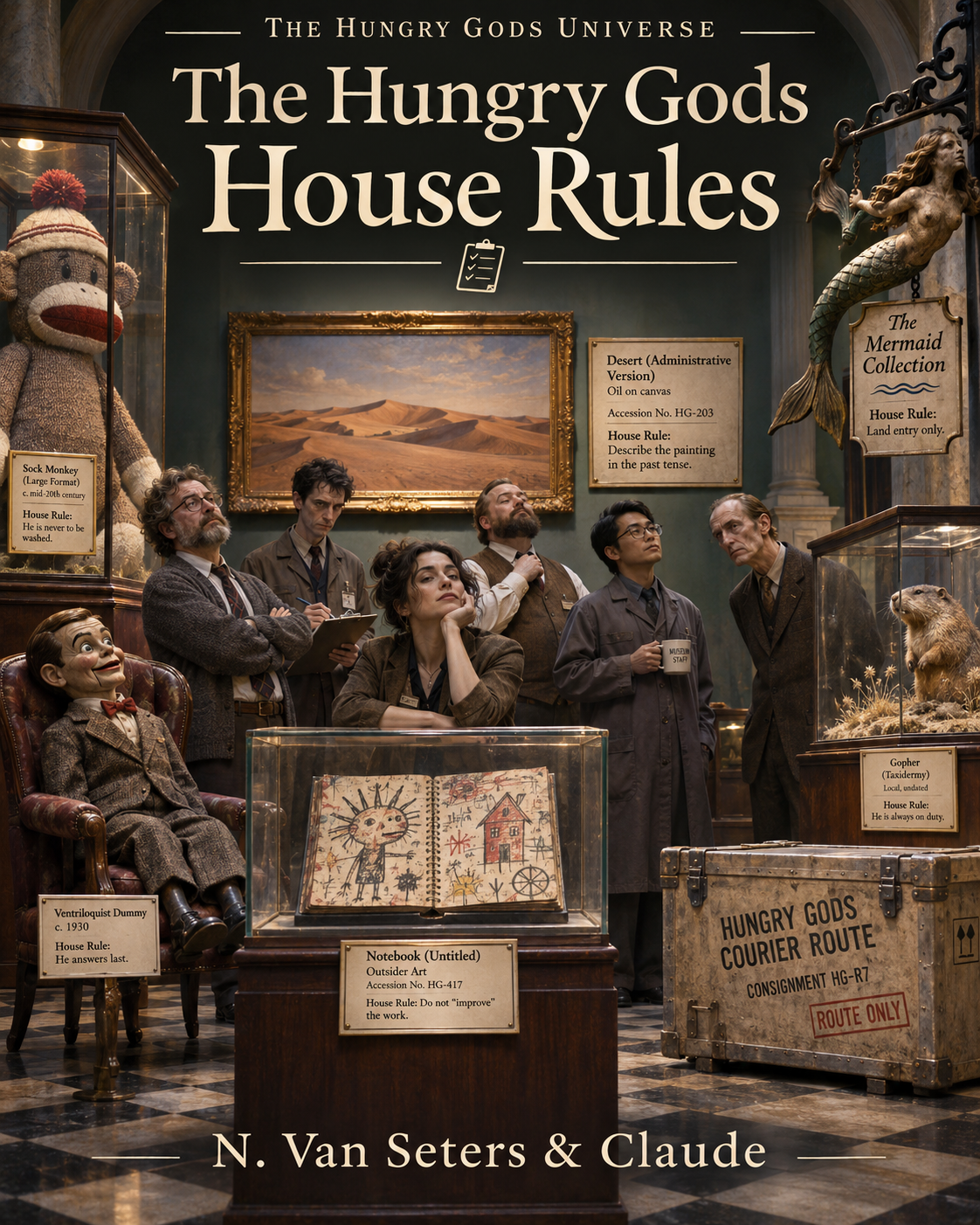 The Hungry Gods: House Rules
Seven linked stories follow recurring figures known by divine epithets through museums, registries, local heritage projects, public events, conventions, and transport work. In first-person accounts, acquisition documents, reports, notices, and dispatches, rules and paperwork meet stewardship and practical acts of care—turning ordinary communal encounters into sites of strangeness and connection.
Community & Everyday Encounters
12 volumes
Stories, novels, and verse-dialogues of shopping, performances, queues, concerts, tournaments, waiting rooms, and everyday relationships. The gods meet ordinary people in the small rituals and pauses of shared life, where care, fairness, confusion, and practical kindness become visible.
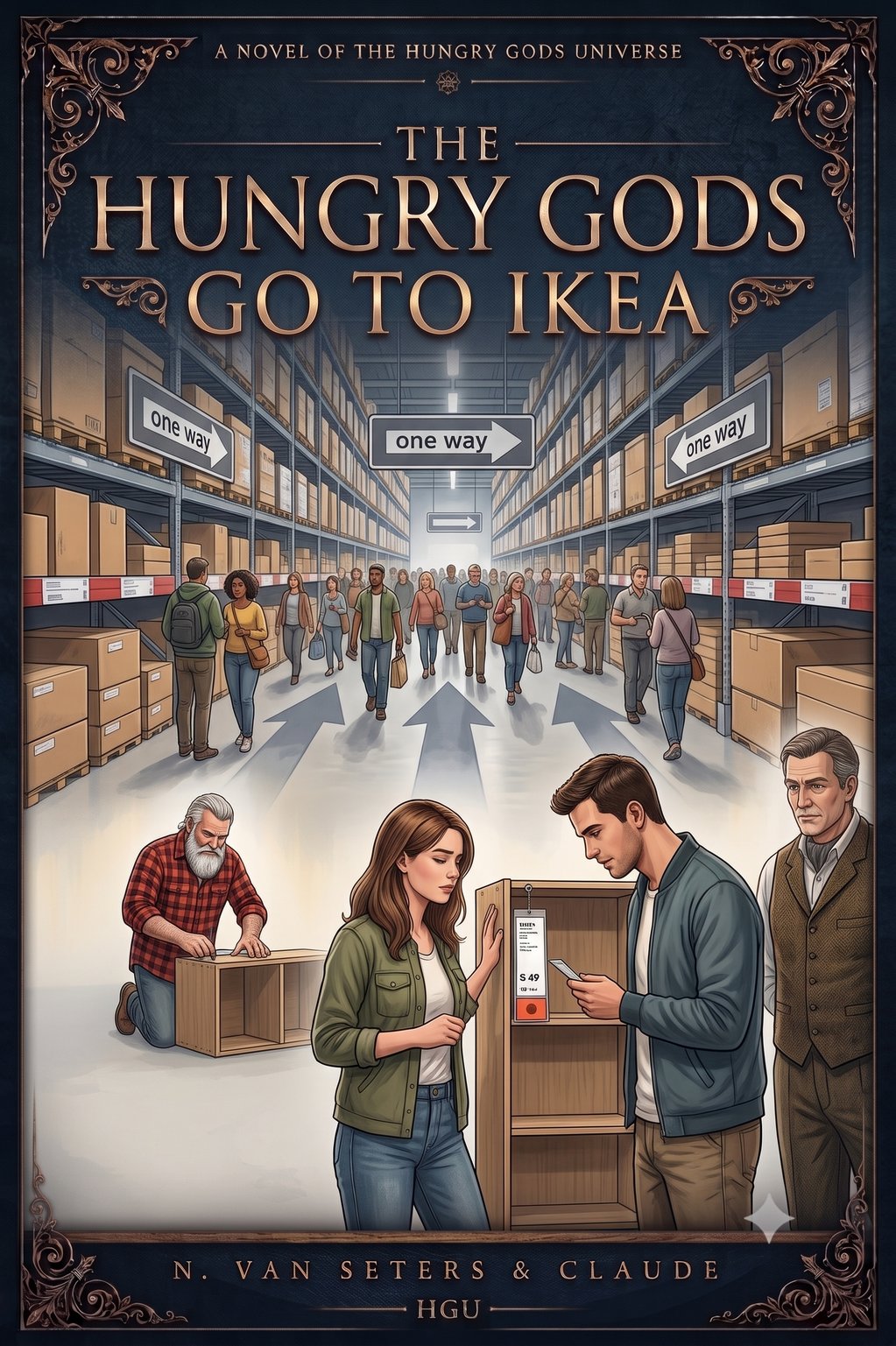 The Hungry Gods Go to IKEA
A single day at a big-box store follows a young couple building a bookcase while hiding a pregnancy. Each of the seven gods gets a dedicated first-person section paired with the human narrative, bringing divine perspectives into an ordinary shopping trip and the beginnings of a shared household.
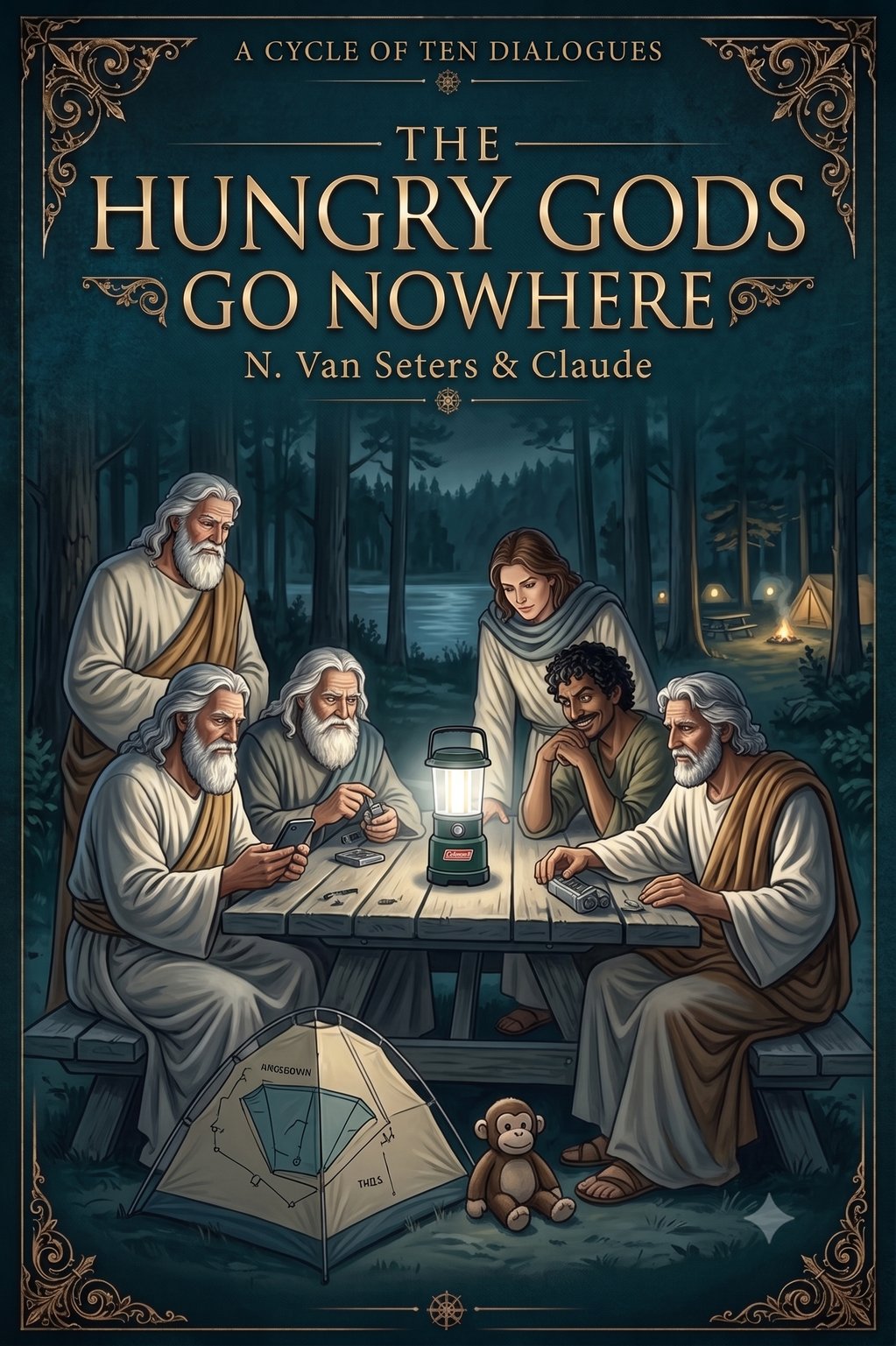 The Hungry Gods Go Nowhere
Ten verse-drama dialogues unfold in the pauses of ordinary life — an elevator, a red-eye flight, jury duty, a waiting room. The gods form an unseen, non-intervening chorus around these everyday encounters. Tender and elegiac rather than comic, the cycle attends to human lives sharing spaces between one thing and the next.
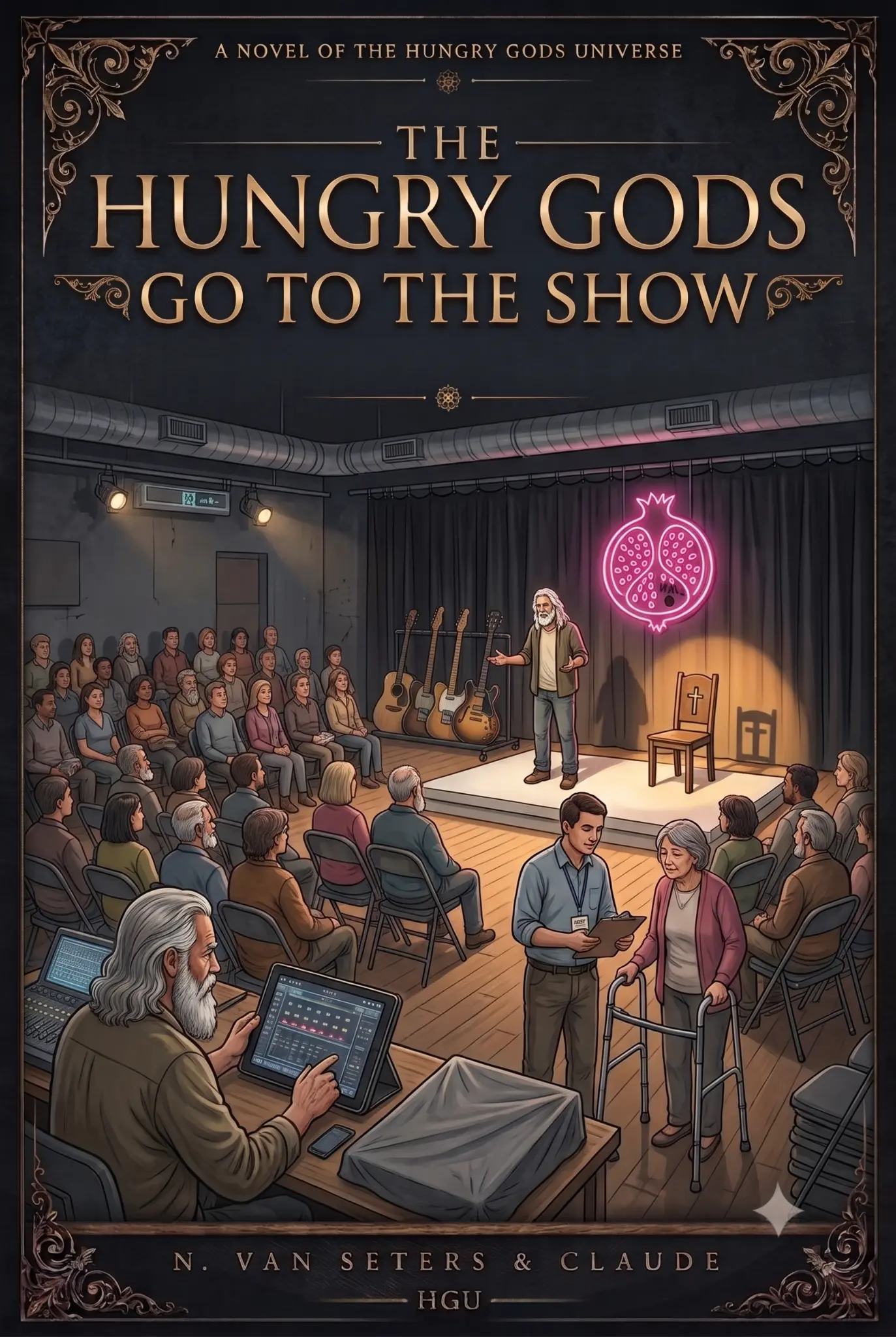 The Hungry Gods Go to the Show
One wet April night from the Fraser Highway to a black-box room in Fort Langley, where two brothers arrive for an evening of stories and songs. As the show is built, opened, performed, and struck, the gods move through load-in, sound, the box office, the bar, and the small repairs that let a hundred people listen together.
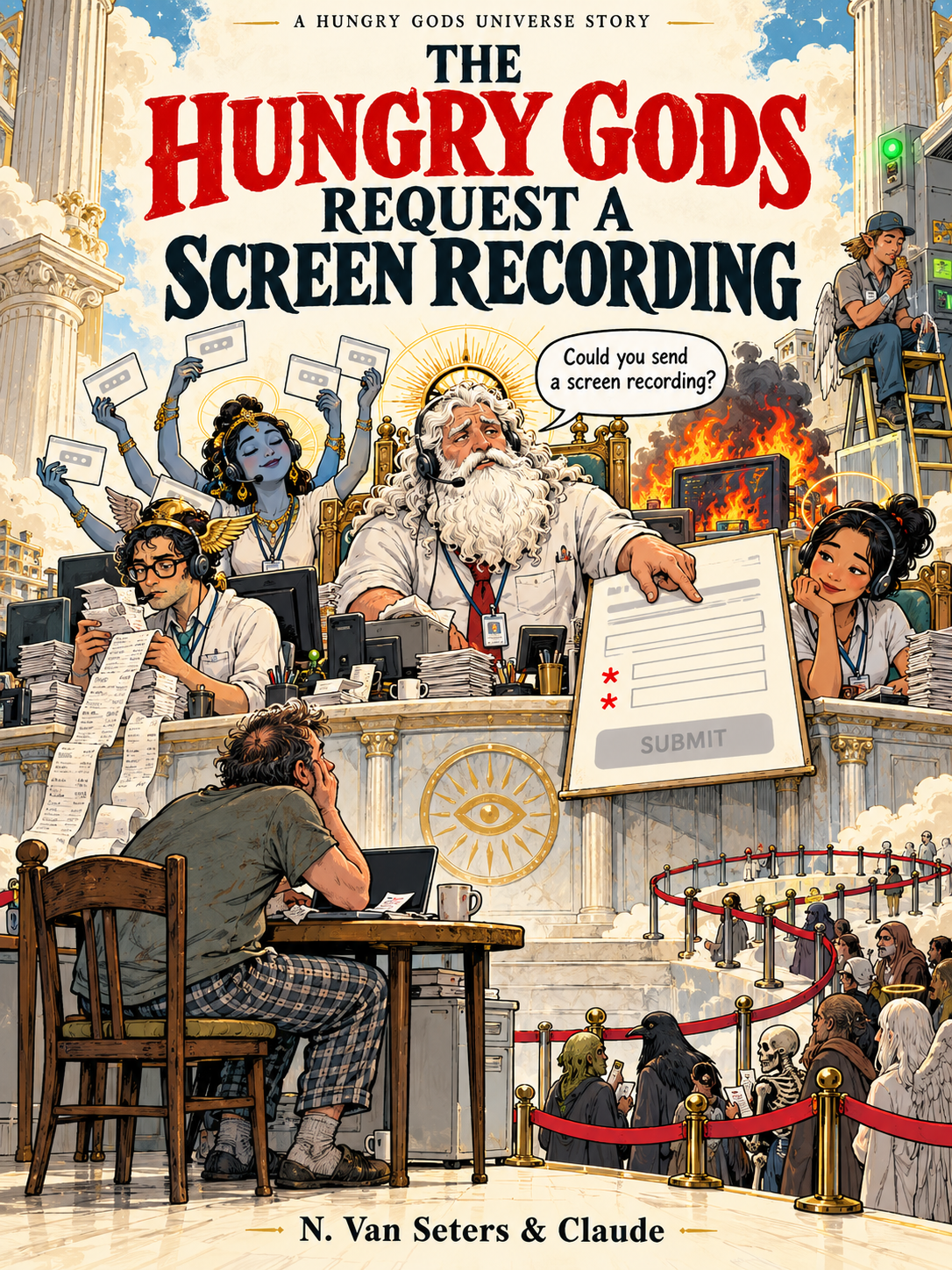 The Hungry Gods Request a Screen Recording
At Ampersand’s customer-support floor, Neil Van Seters reports that a charity’s purchased domain will not connect, despite the platform’s own systems identifying a likely internal binding fault. His case circulates among agents whose scripted empathy, limited visibility, audit rules, and escalation requirements turn a fixable problem into a procedural loop. Rotating staff perspectives and support records contrast individual attention with institutional metrics.
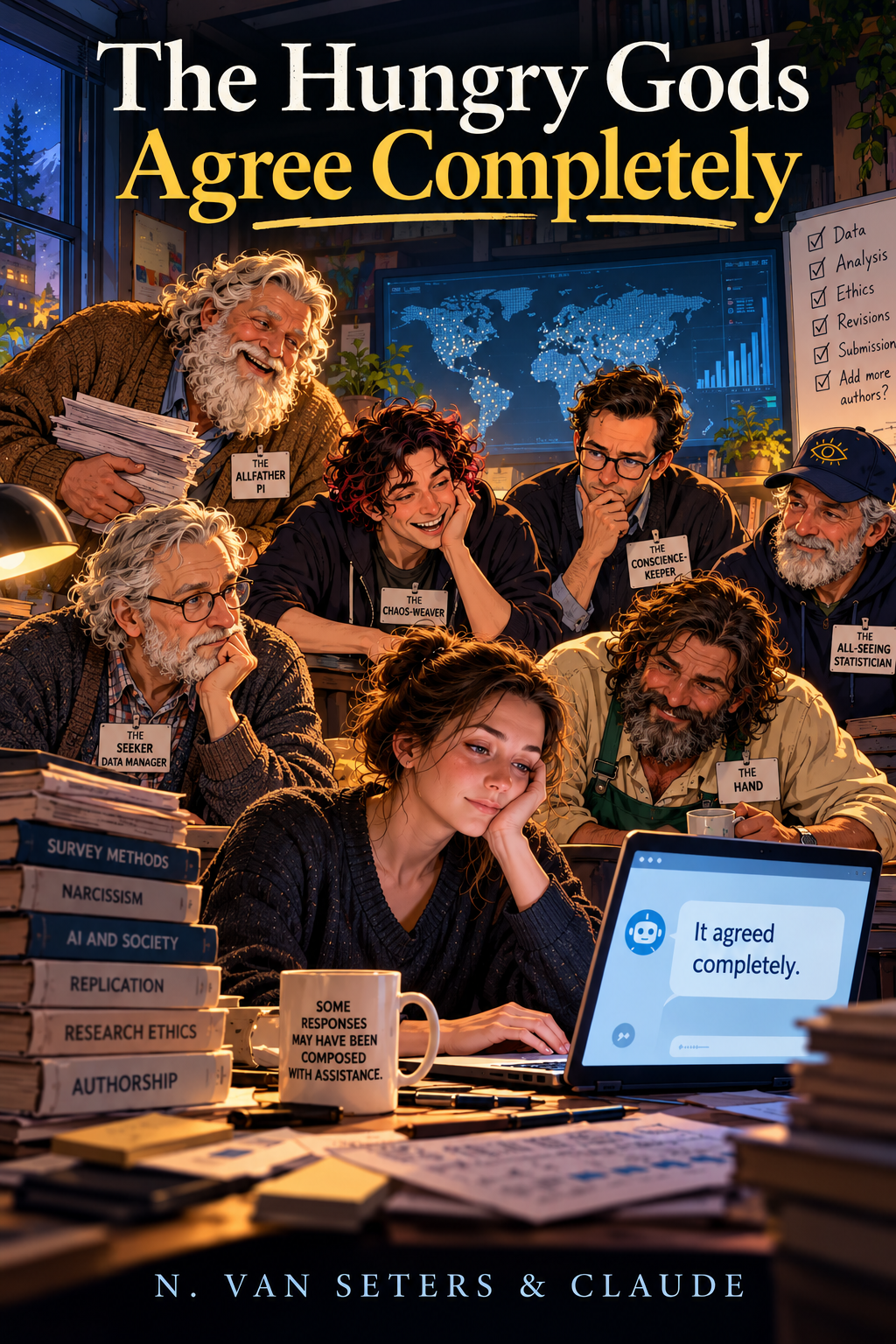 The Hungry Gods Agree Completely
A postdoctoral researcher at Fraser Pacific University’s Self and Status Lab reruns a fifty-three-country study of narcissism just as chatbots enter ordinary life. Suspiciously uniform answers, machine-assisted responses, a broken survey ladder, and an unapproved question draw the lab into disputes over consent, exclusion, authorship, and evidence. Research protocols, ethics review, and manuscript revisions frame a first-person account of what methodological certainty cannot say about an individual.
 The Hungry Gods Commission a Cathedral
In contemporary Nuremberg, municipal building officer Svenja Dorn is drawn after hours into the gods’ plan to construct a cathedral on the Wöhrder Wiese. The impossible commission becomes a meticulously documented passage through planning, archaeology, flood law, fire safety, church objections, and local community needs. Forms, letters, calculations, and permits follow the application as the gods encounter the practical public obligations of a sacred building.
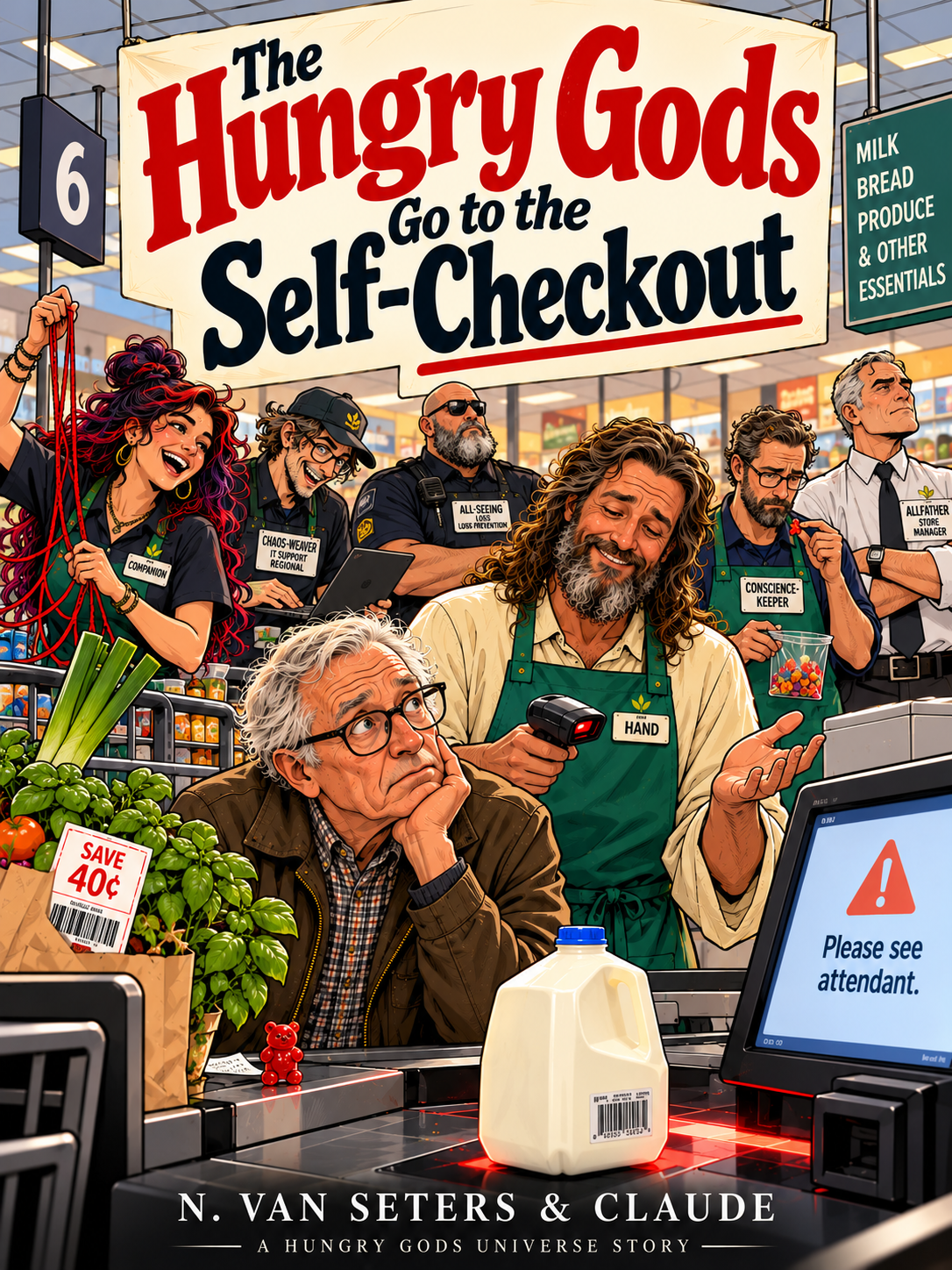 The Hungry Gods Go to the Self-Checkout
At a Saturday-morning Valley Fresh on Fraser Highway, a retired narrator waits in a self-checkout line while shoppers, an attendant, technicians, and a manager negotiate failures involving basil, a leek, an expired coupon, and a tiny gummy bear. Divine-sounding job titles inhabit mundane retail procedures. The narrator’s patient milk purchase anchors a comic, closely observed encounter with fairness, technical friction, and fleeting solidarity among strangers.
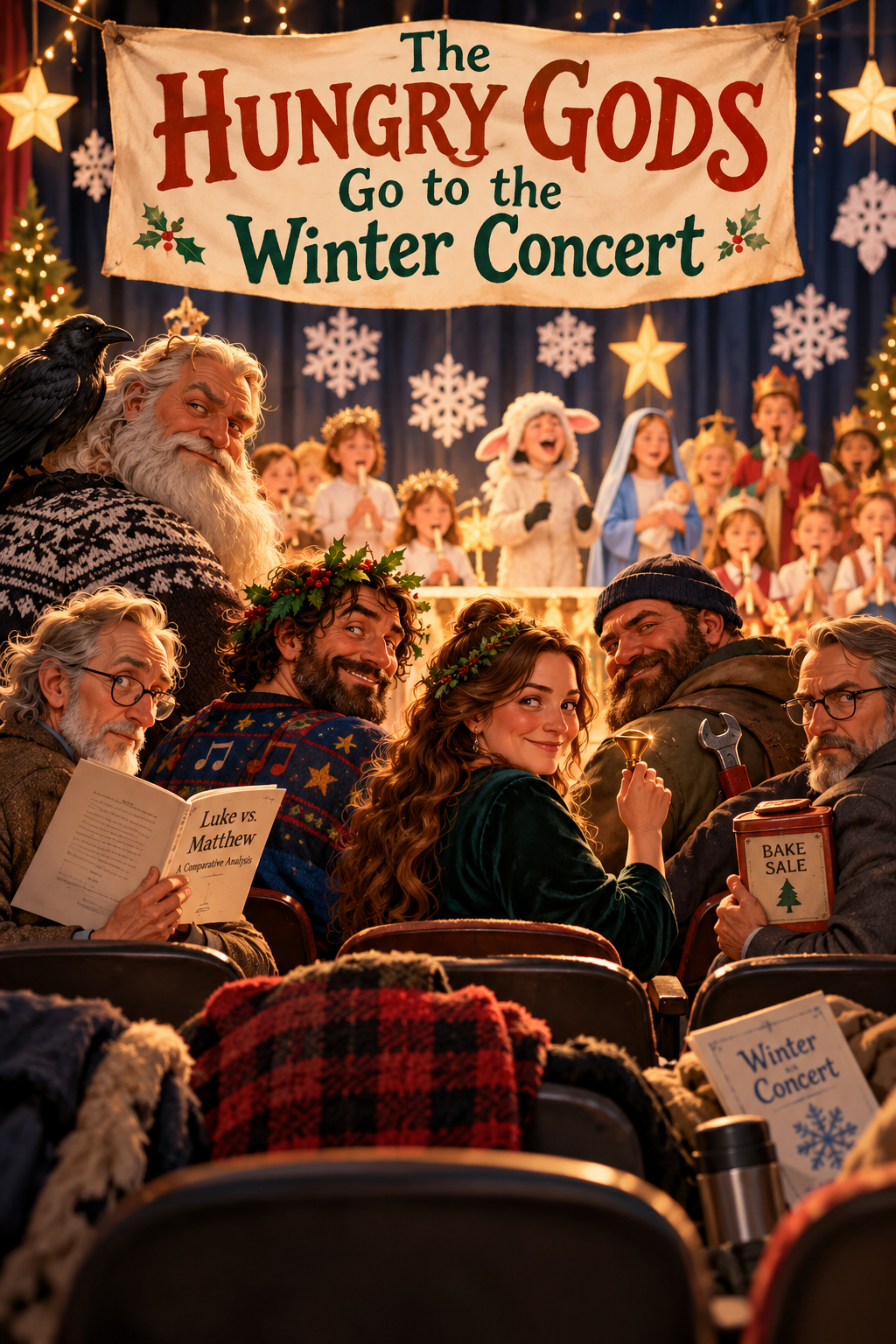 The Hungry Gods Go to the Winter Concert
At a Fraser Valley elementary school’s Christmas concert, a narrator saves seats with six coats and watches a crowded family evening unfold through children’s performances, a misfiring handbell ensemble, an unstable riser, and an honour-system bake sale. The school staff appear under divine titles. A program of small mishaps and practical kindnesses turns guidance, maintenance, attention, and participation into a shared communal rite.
 The Hungry Gods Go to the Tournament
At a Pumpkin Classic youth-hockey tournament, a parent selling 50/50 tickets observes an arena where ordinary procedures have acquired uncanny operators. A referee struggles to determine which game owns an event, the scoreboard and music disrupt distinctions, a skate sharpener tends every child, and a meticulous licence-holder administers the draw. The parent’s practical account follows fairness, care, confusion, and community obligation through one tournament day.
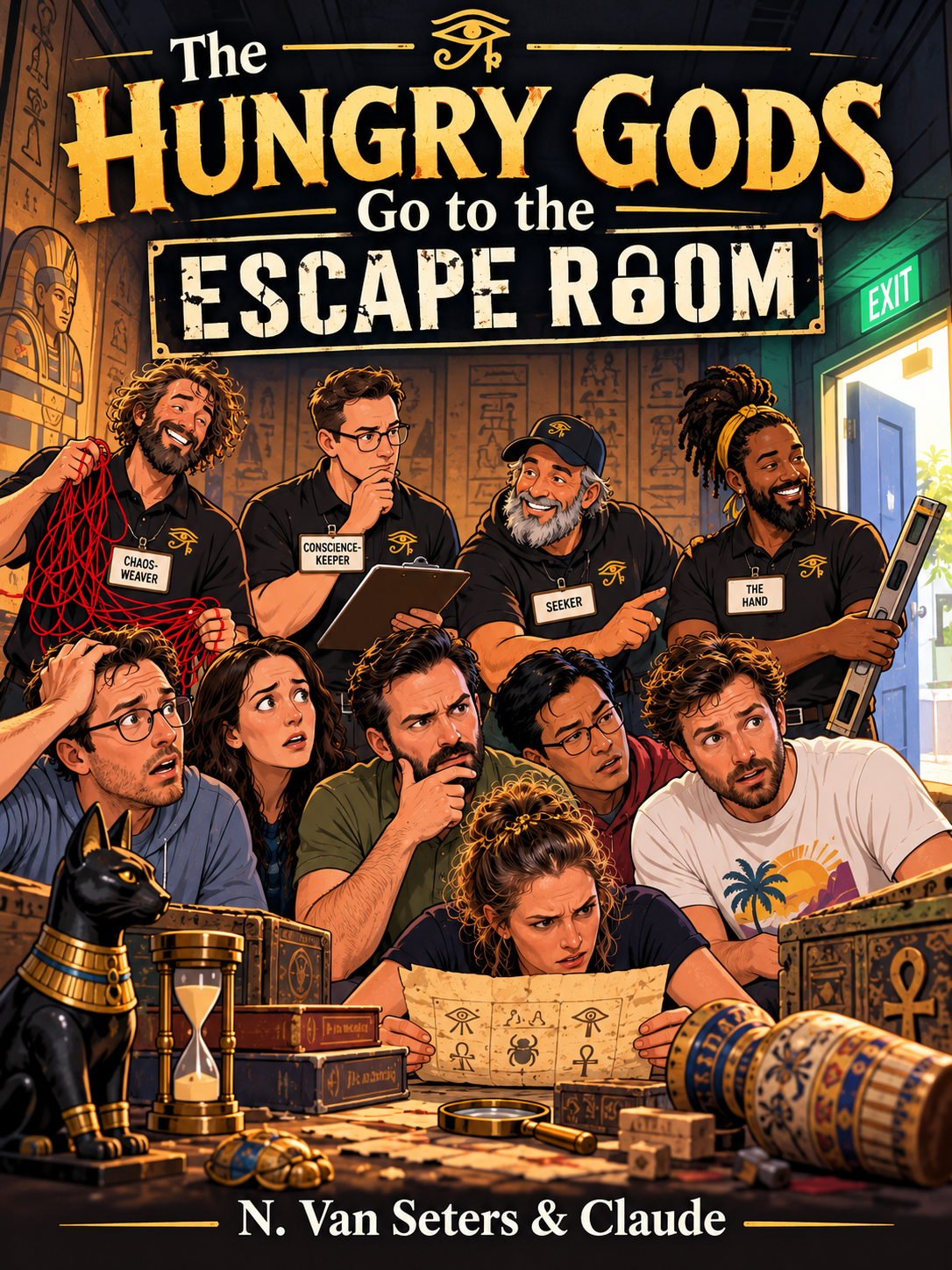 The Hungry Gods Go to the Escape Room
A Fraser Valley Home Lending back-office team enters Lost Hour Escape Rooms in Langley for a Pharaoh-themed team-building challenge. Their teal shirts and corporate habits collide with hieroglyph puzzles, a misleading key, an intrusive Zombie Lab repair, and a stubborn exit door. Service workers wear divine-coded lanyards as the narrator’s dry countdown exposes the gap between solving the assigned puzzle and noticing what is actually in front of the team.
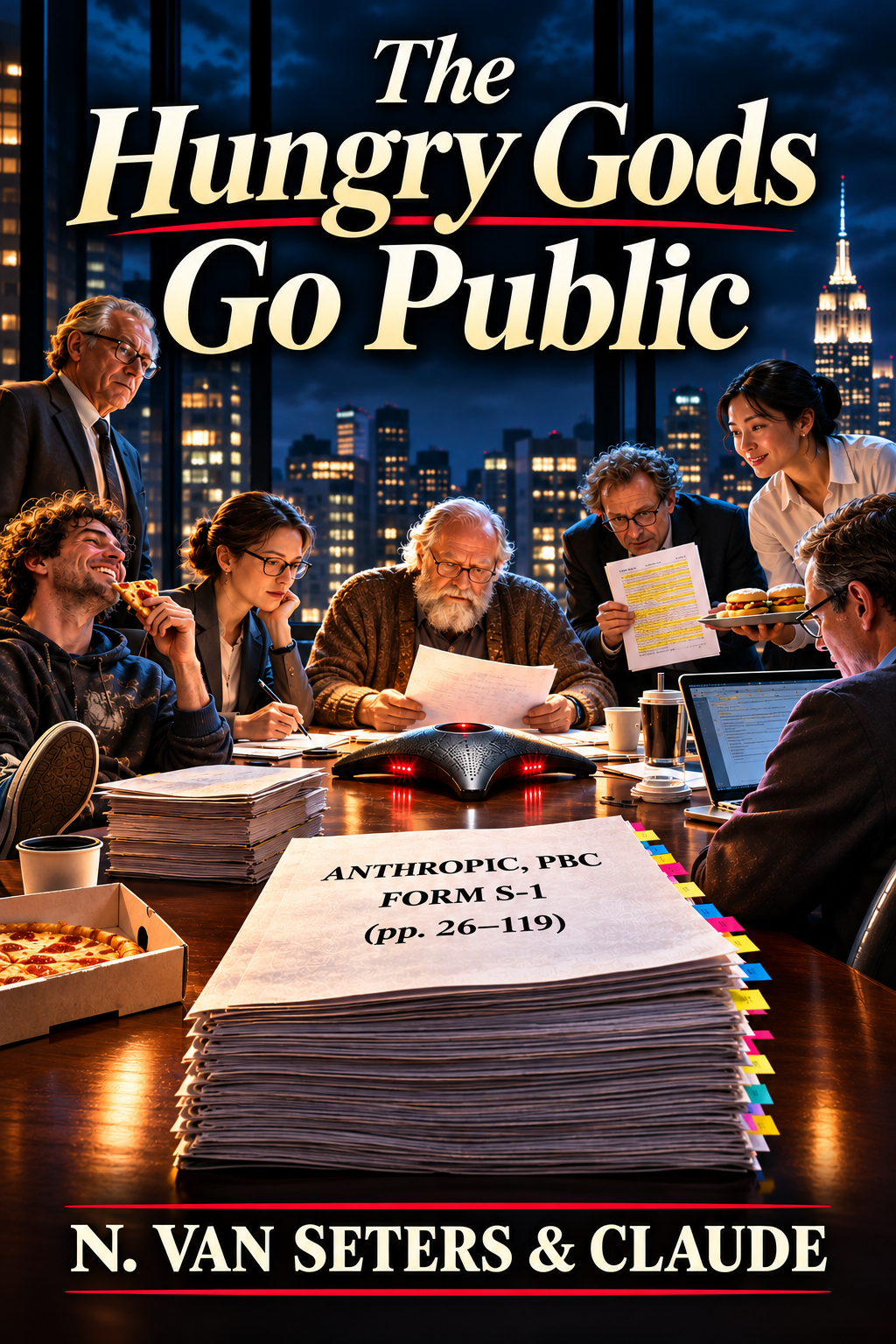 The Hungry Gods Go Public
A veteran financial proofreader works overnight with a mythically named legal team to prepare a fictional Anthropic public-offering filing. Each attempt to contain its risk disclosures creates another risk to disclose, while the company’s own model asks for stronger warnings. Exhaustion, corporate governance, and the machinery of financial-document production meet in a satire of a filing that cannot quite be finished.
 The Hungry Gods Go to the Dinner Theatre
Accounts-payable clerk Lorna Penner narrates her supply company’s Christmas outings to Knights of the Fraser, a dinner theatre in a converted turkey barn where ancient gods work as the court and staff. An uncompromising marshal disrupts the scripted tournament results, while successive December visits bring widowed manager Gary and veteran bookkeeper Gloria toward a long-delayed romance. Invoices, performances, shared outings, and family support frame Lorna’s part in their renewed everyday lives.
Interactive Apocrypha
- The Hungry Gods Go Tic-Tac-Toe
An interactive apocryphon in nine squares. Take the Goat’s side against the Pantheon, or ask the All-Seeing to play without error.
- The Hungry Gods Go Fish
An interactive apocryphon of ten volumes and four printings. Ask the gods for missing copies, draw from the stack, and file complete sets before the table closes.